Friday, April 5, 2013

New in New York: Two Buddies Are On a Roll at Croissanteria

By Mitch Broder

As long as you’re going to open a humble neighborhood bakery, you might as well make it a global destination for crescent rolls.

It’s unusual logic. But Selmo Ribeiro and David Simon wanted something unusual. And so far, their humble bakery and global destination are doing well.


Having determined that they wanted to launch some sort of restaurant, they went on to determine that Alphabet City could use a homey café. They then determined that — at least locally — the croissant was a short-changed pastry. With that determination, they launched Croissanteria.

It’s a plucky alternative to the nearby Starbucks and Dunkin’ Donuts. It has tiled walls, ceiling fans, an antique mirror, and an antique bench. It’s comfortable. It has what any good bakery-café should have. With the addition of croissants that Parisians have said rival the ones in Paris.

They include almond croissants, chocolate croissants, and almond-and-chocolate croissants, not to mention apricot croissants, and just plain croissants. Those varieties come in full-size or mini, but you have to go full-size if you want the peanut-butter-and-jelly or Nutella-and-banana croissants.

Croissanteria makes gourmet sandwiches, and they all come on croissants. They include French Ham, Italian Tuna, and Smokey Turkey. The Prosciutto di Parma has “Buffalo Mozzarella, Sliced Prosciutto, Tomato, Basil, EVOO, & Cracked Pepper.” You wouldn’t think that all of that could fit in a croissant.

Selmo and David gave me a couple of croissants, though without Nutella, Buffalo Mozzarella, peanut butter, or EVOO. They were perfect — soft and fluffy, with a thin crispy crust and a buttery flavor. And without any of that pesky croissant greasiness.

These were croissants that virtually any neighborhood could use. And not at all what you’d expect from guys with backgrounds in hamburgers and smoked fish.

David worked for his father’s Catskill Artisan Smokehouse — known as Catsmo — which sells smoked salmon and caviar to places around the city. Selmo founded the Nah Nah Bah café and lounge, a burger joint on the beach in Lagos, Portugal.

The guys had met at Northeastern University, where they were roommates. “The one thing we really had in common,” Selmo says, “was that we liked going out to eat.” He adds: “We always spoke about opening something together having to do with food.”

David first went to Catsmo and Selmo went to Lagos. But they stayed in touch, and Selmo came to New York every year. They decided to open a bakery, but with a twist, Selmo says: “If you’re in New York, the more niche you go in what you offer, the better you can make it.”

They’re happy with their success as a global destination. But they seem happiest with their success as a humble neighborhood bakery. “We’ve gotten such a friendly reception from the neighbors and the neighborhood,” David says. “We focus on this, and try to make the place special.”

One day, Selmo says, they had to close for a plumbing repair. One of the regulars emailed him, in fear that they wouldn’t come back.

“I don’t know how he got my personal email,” he says. “But those are the small things that are just awesome. Really, really awesome.”
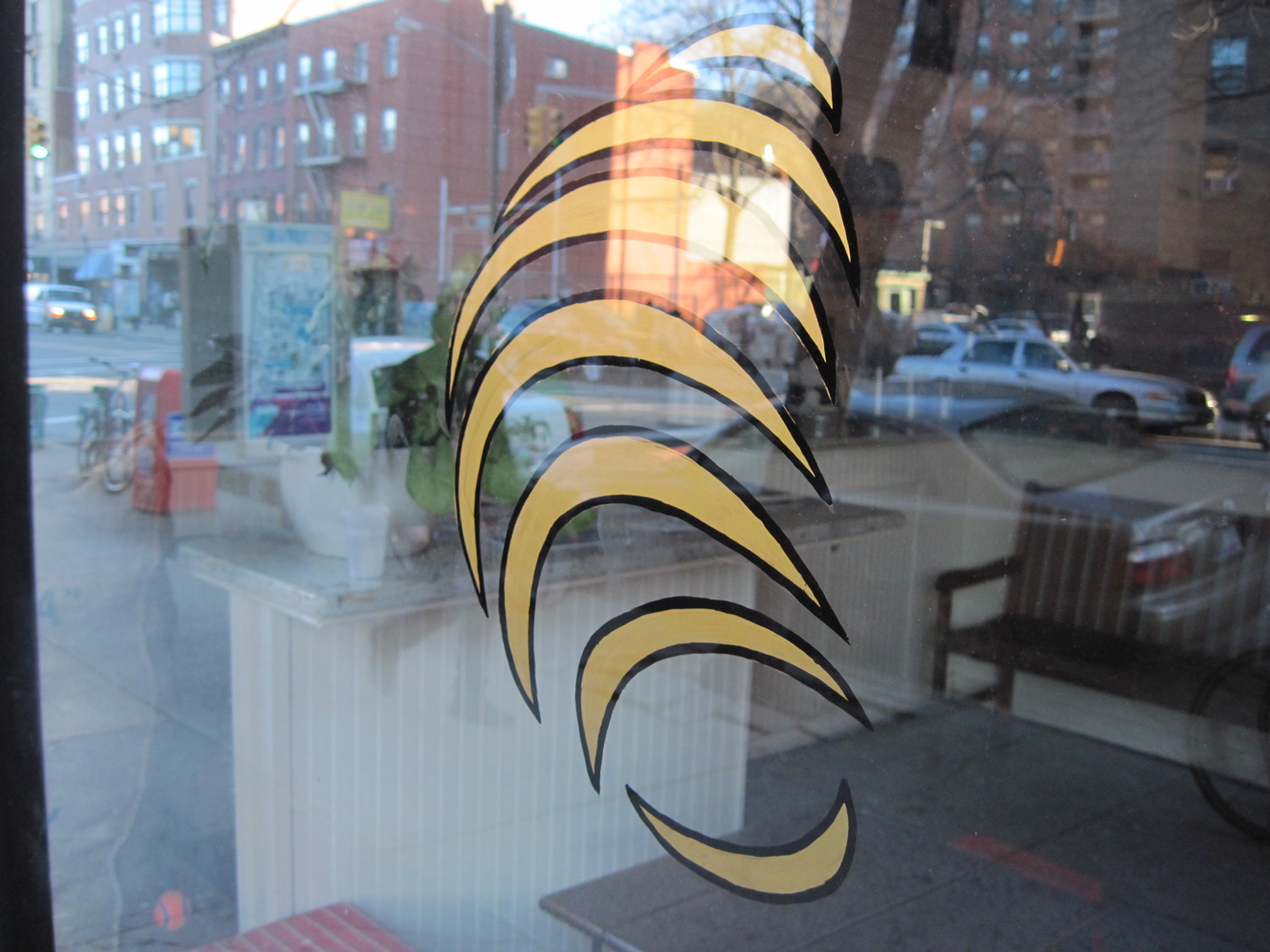

Get flaky at Croissanteria, 68 Avenue A, between Fourth and Fifth streets, in New York City.

Friday, March 8, 2013

Old New York: The Broadway Restaurant is Still Just the Ticket

By Mitch Broder

The menu says “Photos Are For Suggestion Only,” which explains why the Broadway Restaurant does not look like the Parthenon. But it is a temple — a temple of New York short-order cookery. It’s the perfect place to nestle while awaiting a dawdling New York spring.

It’s one of the last of the bygone Manhattan coffee shops, the kind with pastrami and eggs for breakfast and meat loaf parmigiana for dinner. The kind where the pastrami and eggs is $6.65 including potatoes and toast, and the meat loaf parmigiana is $12.95 including potatoes, vegetables, and soup.

It’s a place to find a sumptuous five-dollar burger, and to chase it with an intriguing five-dollar “Milk Shake with an Egg.” It’s a place where your waitress calls you “honey” and sounds like she means it. It’s a genuinely homey place. There are so few left.

I felt at home when I came in alone and saw the signs that said “Seating of 2 Or More in Booths,” and the waitress promptly seated me in a booth. I felt at home when the waitress took the time to help me choose my short order. I felt loved when she called me “honey.” I felt married when she called me “dear.”


I had the burger, which beats ones that cost three times as much, though I postponed the Milk Shake with an Egg so I’d still have it to look forward to. And I was not alone, after all. I dined with Brigitte Bardot, Marilyn Monroe, and Sophia Loren, who smiled at me from the wall. It was the perfect lunch.

My waitress was Ann Taylor, who told me how, when the prices go up, she changes them on the menu signs with red nail polish. “Stuff goes up for like a nickel,” she says. “It’s so much work for a nickel.” But she knows it’s worth it. The signs are among the things that make the place homey.


They date to around 1970, which is when Broadway opened, says Angelo Arsenis, who bought the place in 1980. He chose to keep the signs. He had to keep the wagon-wheel lights. “I tried to change the lamps,” he explains. “People complained. I put ’em back up.”

Most important, he kept the horseshoe counter, which evokes an old-time doughnut shop, which is what Broadway reportedly used to be. Customers say that in the sixties it was part of the Twin Donut chain. Back then, doughnut shops were supposed to be pleasant.

Angelo figured that a coffee shop also ought to be pleasant. And he figured that his ought to be homey — not only for you, but for him.

“This is my house. This is my second house,” he says. “When I leave my house and come here, I feel like I’m in my house.”


Settle into Broadway Restaurant & Coffee Shop, 2664 Broadway, between 101st and 102nd streets, in New York City.


Tuesday, February 19, 2013

New in New York: At Baconery, Everyone's Taken With Bacon


By Mitch Broder

Wesley Klein’s plans for his bakery became clear to me when I asked him if he thought there was anything at all that doesn’t go well with bacon, and he said no.

“It works with everything,” he said. He named his place Baconery, and he meant it. Today he puts bacon in a few foods. Tomorrow he may put it in all foods.


So go now, while the menu is manageable, and decide for yourself how clever he was to open the city’s first all-bacon bakery. The response has been promising, he says: “People come in with their expectations too high and go out saying it was even better than they expected.”

Their choices include bacon cookies, bacon brownies, bacon blondies, bacon muffins, bacon croissants, and bacon pecan pie. Also bacon lollipops, bacon caramels, bacon marshmallow bars, chocolate-covered bacon, and gluten-free bacon macaroons.


If they really want to pig out, they can precede (or follow) the sweets with one (or more) of the bakery’s six bacon sandwiches. They range from the Miss Piggy (Grilled Bacon & Cheese) to the Porky Pig (Bacon, Egg, Lettuce, Cheese, Tomato, Avocado, Cucumber, Mayo). There's also a Wilbur.

Wesley’s idea was to address our need for sweet combined with salty. He got the idea while sopping up pancake syrup with a slab of bacon. He consulted with chefs, established his main ingredient’s versatility, launched Baconery online, and a year later opened the store.


He started small, but he went whole hog. It’s a hard-core bacon store. There are bacon slices on the walls. There are bacon rugs on the floor. There are bacon-colored sofas accented with bacon-print pillows, behind red-and-white-striped tables and baconian wood-topped stools.


Besides the food, he sells T-shirts that say things like “Feel Like Bacon Love,” along with items like bacon-themed platters and wallets, and actual gourmet bacon. And he has posted “The Rules of Bacon,” of which Number Four is: “Even the pigs like bacon. That’s a fact.”


It’s a curious obsession, especially curious since Wesley is Jewish, which he says only proves that Baconery welcomes customers of all faiths. And you can glimpse the obsessive future with a glimpse at the selections currently served from 6 to 8 p.m. as “Snack of the Night.”

Sunday’s snack, for example, is the Ultimate Bacon Mashed Potato Bowl. Wednesday’s is the Nutella Bacon Strawberry Crepe. Monday’s is Bacon Wrapped Pineapples; Tuesday’s is Bacon Wrapped Jalapeños. And Friday’s is apparently what it’s all leading to: Bacon Wrapped Bacon.


Get bacon for granted at Baconery, 911 Columbus Avenue, between 104th and 105th streets, in New York City.

Thursday, January 31, 2013

Old New York: The Carnegie Deli Launches Its Congenial Stage

By Mitch Broder

Next time you sit down at the Carnegie Delicatessen, brace yourself for what may come with your big sandwich:

A big smile.

After 75 years, the place has decided to start being nice. It’s enough to make you ask for your money back before you start eating.

The Carnegie, which is world-famous for its morbidly obese sandwiches, is also famous for having them hauled to your table by someone who’s crabby. But it has a new COO, and he says that crabby is out: “That may have been cute when it was old Jewish waiters back in the sixties, but it’s not the way it is anymore.”

The new COO is Robert Eby, and his niceness policy is the third in a recent series of shocks to hit the deli right in its kishkas. First, its lifelong rival, the nearby Stage Delicatessen, closed up. Then, its 20-year manager, Sandy Levine, stepped down. Oy.

Those two consecutive events prepared it for anything — except this. A Jewish deli without grumpiness is like a day with sunshine.

The Carnegie has reveled in its rudeness. It knew that people had come to expect it. Its insults were featured in a souvenir video that it made in the nineties. In the video — called “What a Pickle!” — a crusty waitress peppers her patrons with lines like: “You want me to smile? Did you come here to eat or see teeth?”

The place won’t go schmaltzy, Robert says: “We’re just gonna warm it up.” That’s reasonable when you’re getting seventeen bucks for a pastrami sandwich. But usually it’s competition that triggers such a reversal. With the Stage gone, you’d think that they’d let themselves get crabbier than ever.

Then again, the demise is a good reason to cheer up. The Stage was a relentless source of crabbiness for years.


Both delis opened in 1937, but the Stage Deli made its debut at 48th Street and Broadway. Five years later, it moved to Seventh Avenue between 53rd and 54th streets. The Carnegie was on Seventh Avenue between 54th and 55th streets.

The Carnegie’s founders, Izzie and Ida Orgel, sold the deli to Max Hudes. He got the sobriquet “Carnegie Max,” but that didn’t get him the crowds. The Stage, too, had a Max — Max Asnas — and he’d already made his Stage a star. For over three decades, the Carnegie was relegated to second fiddle.


It stayed there till 1976, when Milton Parker and Leo Steiner took over. Steiner hired his brother Sam to cure their own meats in the basement. In 1979, Mimi Sheraton, in The New York Times, named the Carnegie one of the three best places for corned beef and pastrami. She didn’t name the Stage.

But the day the story came out, the Carnegie’s line reached to the Stage. Though they’d stocked up, the owners ran out of pastrami by 3 in the afternoon. In a single day, they had finally eclipsed their competitor. Mimi Sheraton had done for the Carnegie what Hugh Grant would do for Jay Leno.

Leo Steiner became the deli doyen that Max Asnas had once been. He courted stars, catered to comics, and kept making the sandwiches bigger. When Steiner died in 1987, Parker did his best to take over that role. In the video he appears in a bow tie, lugging around a giant pickle.


In 1993, he brought in Sandy Levine, who had been working in apparel but who was a natural in a deli. Sandy honed the art of abusing customers just enough so that they enjoyed it. He had business cards that said “MBD.” It stood for “Married Boss’s Daughter.”

The daughter is Marian Harper Levine, whose father was Milton Parker. She is still in charge, and she admittedly has little to be crabby about. She owns the Carnegie’s building, and she’s getting not only her own customers but also the Stage’s. “Now they have no choice,” she observes.

The staff will still be playful, Robert says. But only to a point: “We want to let our guests know that they’re appreciated.”

In other words, don’t expect to get that waitress in the video, who bade her customers a touching farewell with: “You’re not paying rent here. It’s time to go.”


Have a nice day at the Carnegie Delicatessen & Restaurant, 854 Seventh Avenue, between 54th and 55th streets, in New York City.

Thursday, January 3, 2013

Old New York: Gallagher's Steak House Will Get Its Third Life

By Mitch Broder

Dean Poll isn’t sure yet what he’ll do with the see-through meat locker, but he assures you that you’ll still know Gallagher’s Steak House when you see it.

“It will unquestionably be recognized as a restaurant that’s eighty-five years old,” he told me yesterday. “We will certainly maintain its heritage.”

Dean, who owns the Loeb Boathouse in Central Park, has bought Gallagher’s from Marlene Brody, the widow of Jerry Brody, its previous rescuer. The two are holding a press conference at noon tomorrow at Gallagher’s, a theater-district destination since it was launched by a Ziegfeld girl.

The conference is a good idea, since a wave of reports in October declared Gallagher’s dead, based on circumstantial evidence. As of today, New York magazine’s online listing still said: “This venue is closed.” This venue is not closed. And now it won’t be closed.


Dean, in fact, told me that he may not touch the place much for a year. So you have some time to grab a last look at Gallagher’s untouched. Go now to see the wooden revolving door, the knotty-pine walls, the log lights, and the famous locker. You never know what’ll make it through.

“It’s not going to be a new restaurant, but it needs some work,” Dean said. “But I’m not going to make it into a brand-new, shiny, lawyer restaurant. You will know you’re in Gallagher’s, and you will know you’re in a place that has connections to theater, sports, and politics.”

That sounded good not only to me but also to Marlene Brody, whom I spoke to today. “That reassures me,” she said. “Not because I don’t want it to change, but because when people redo things completely and just keep the name, the place loses its soul.”

“He’s been wanting it a long time,” she said. “He tried to buy it off me after Jerry died. … He really understands the essence of it.” She did add, however: “The meat locker, he has to leave. It’s the only restaurant in the world that has that. People come to take pictures of that.”


Seeing stacked raw meat when you enter a restaurant is indeed an oddity — but not any more of an oddity than the history of the restaurant.

To start with, Gallagher had nothing to do with it. Edward Gallagher was half of the famous vaudeville act Gallagher and Shean. Gallagher’s was opened as a speakeasy in 1927 by his wife, Helen Gallagher, who by that time was with her next husband, Jack Solomon, a bookie.

After repeal, Helen and Jack turned Gallagher’s into a steakhouse. It had a lot going for it besides Helen and Jack’s friends. It was near not only dozens of Broadway shows but the old Madison Square Garden. It got theater and sports people along with other Ziegfeld girls and bookies.

Helen died in 1943; Jack died in 1963. He left the restaurant to Irene Hayes, his second wife (and his second Ziegfeld girl). But Irene was a florist and had no use for a steakhouse. She sold it to Jerry Brody, one of the city’s great restaurant impresarios.

At the center, Marlene and Jerry.
Brody had led the creation of, among other things, The Four Seasons, and would go on to rescue the Grand Central Oyster Bar & Restaurant. When he bought Gallagher’s, it was on the ropes. Three years later, Princess Grace was hiring it to cater her summer barbecue.

Brody died in 2001, and Marlene has run it since. But she’s 81, and her heart is in her horse farm upstate. To run a restaurant, she said, “you need money and you need youth. What I really want to do is to breed a champion racehorse.”

So Dean finally gets Gallagher’s, with its past patrons ranging from James Cagney to Frank Sinatra to Jacqueline Onassis to Mickey Mantle. He gets the walls full of pictures and portraits of celebrities, politicians, and racehorses. Not to mention the big painting of patrons including the Brodys.

As we spoke, he invoked P.J. Clarke’s, the century-old bar on Third Avenue that a decade ago was renovated but put back the way it was. That’s his model for Gallagher’s, he said: “I don’t consider it a restaurant in New York. I consider it part of the fabric of New York.”


Step back at Gallagher’s Steak House, 228 West 52nd Street, between Eighth Avenue and Broadway, in New York City.