Showing posts with label Lower East Side. Show all posts

Wednesday, October 17, 2012

New in New York: Populence and Pop Karma Make a Crop Pop

Delicious popcorn at the New in New York popcorn venue Pop Karma
By Mitch Broder

For Porcini Cheddar popcorn, you want the East Side. For Three Cheese popcorn, you want the West Side. Then again, for Pumpkin Spice popcorn, you want the West Side, whereas for Bacon Apple Bourbon Caramel popcorn, you want the East Side.

It could have been simple. But nothing ever is. So the popcorn department of your life just got complicated. Through what you’d have to call karmic opulence, New York has just furnished you with two new popcorn shops — Pop Karma and Populence.

Visit the New in New York Populence

Each is a little place run by a woman inspired by corn. Both popped up at practically the same time, though apparently by coincidence. Each offers popcorn in flavors that you don’t get in cellophane bags. Both sell popcorn with a conviction that it will make you happy and healthy.

Pick your popcorn flavor at Pop Karma

So take your pick. Or don’t, for if you love popcorn, you’ll want to try both. They’ve made themselves just different enough so that you have no choice.

The menu at this New in New York establishment makes your mouth water
Populence, in the West Village, is run by Maggie Paulus, whose very life was essentially launched by popcorn. “My dad proposed to my mom with a ring in a Cracker Jack box,” she told me. “So growing up, popcorn was always associated with something fun.”

Pop Karma, on the Lower East Side, is run by Jean Tsai, who wants to inspire you in much the same way that popcorn inspired her. On the chalkboard outside her store, she puts inspiring quotes like Herbert Spencer’s “The great aim of education is not knowledge but action.”

A white board of popcorn goodness at the New in New York Pop Karma
Populence carries six flavors at a time — usually three sweet and three savory. The top sellers have been Salted Caramel, Sun-dried Tomato, and Jalapeño Cheddar. There’s also Kettle Corn, Ginger Caramel, Garlic Rosemary, Real Raspberry, and Sweet Cinnamon. Salted Caramel could count as sweet and savory.

Pop Karma carries six flavors at a time — usually three “classic” and three seasonal. The classic are Caramel, Mediterranean, and Zen Cheddar. The seasonal have included Barbecue, Margarita, and White Truffle Cheddar, and now include Za’atar, which is described as “a visit to a Middle Eastern souk.”

The Populence Web site says: “Our artisanal method of creating cornfections involves small batches of heirloom popcorn combined with the finest whole ingredients.”

The Pop Karma Web site says: “Our ingredients lists are minimal since we source the best food possible from responsible, sustainable producers.”

It’s close, but I have to give that round to Populence, because of “cornfections,” and in spite of “heirloom.”

Don't stop with just a days worth of popcorn, bring a bucket of Populence home with you

Maggie and Jean, of course, are not the first to have popcorn stores in New York, regardless of which one of them thought of having one first. Awhile ago, Times Square had a store called Popcorn, Indiana. In the eighties, the Upper East Side had Jack’s Corn Crib. The Jack was Jack Klugman.

Those are gone, of course. But they were chains. Pop Karma and Populence aren’t. Yet. And their owners both seem devoted to their products and their neighborhoods.

As the Pop Karma Web site puts it: “Kind words and kind actions inspire a beautiful day. A lifetime of beautiful days is a work of art. Live it.”

A good sign is an imperative for any New in New York establishment

Pop into Populence, at 1West Eighth Street, and Pop Karma, at 95 Orchard Street, in New York City.

Thursday, September 13, 2012

Old New York: Stars Dim on the Yiddish Theater Walk of Fame

A faded star for Daniel Libeskind on the old new york landmark the Yiddish Theater Walk of Fame
By Mitch Broder

In a sense, it won’t matter when you finally can’t read the names, because most people already don’t recognize the names. Or at least they wouldn’t recognize the names if they tried to, which, at least for the most part, they don’t.

The names are of stars of New York City’s Yiddish theater. They’re engraved in granite slabs, which are on Second Avenue at 10th Street. Unfortunately, the granite slabs are embedded in the sidewalk, and the sidewalk is often used by people heading for Ninth or 11th Street.

So the people walk on the slabs, which is forgivable, and the names get gradually scuffed away, which is regrettable. But the man who got them embedded has been dead for sixteen years, and now the slabs, apparently, are the domain of nobody in the world.

Foot traffic has eroded the names along the Yiddish Theater Walk of Fame an old new york landmark

Yiddish theater flourished here from the 1890s through the 1930s. Theaters for its shows clustered on Second Avenue below 14th Street. The stretch, which was then regarded as part of the Lower East Side, came to be something of a second Broadway, at least if you understood Yiddish.

Many of its stars moved on to the first Broadway, as well as to movies and television. Probably the most famous of them was Paul Muni. He starred in classic films like “I Am a Fugitive from a Chain Gang.” But even his is no longer a household name, which doesn’t bode well for Maurice Schwartz.

Moved by the stars’ fate, Abe Lebewohl came to their rescue, perhaps because he was in a unique position to do so. In 1954, he had opened the 2nd Ave Deli. In 1985, he installed the Yiddish Theater Walk of Fame in front of it.

The founder of the Old New York landmark the Yiddish Theater Walk of Fame Abraham Goldfaden's star

It consists of about thirty markers, mostly in two rows, mostly with two names to a marker. Most of the names are inside of stars — not Jewish stars but Hollywood-Walk-of-Fame stars, signifying that the tribute was as much to talent as it was to heritage.

There is David Kessler with Zvi Scooler. There is Leon Liebgold with Lilly Lilyana. There is Boris Thomashevsky with Bessie Thomashevsky. Boris, at 13, helped to bring Yiddish theater to New York. His grandson is the conductor Michael Tilson Thomas.

In 1996, Abe Lebewohl was murdered. His brother, Jack, took over the deli, but ten years later he closed it. The year after that, his sons Josh and Jeremy reopened the 2nd Ave Deli — but on 33rd Street, between Lexington and Third.

Last year they opened a second branch, on First Avenue at 75th Street. There they installed an Automat section that had been on display at the original store. I’m sure that they’d like to have the walk of fame  at the new store, too. It’s kind of hard to fault them for not dislodging and moving a city sidewalk.

An old new york staple Automat returns

On the site of the original store there now stands a Chase bank. Neither the bank nor its building manager seems to want much to do with the walk. Nor does the city, which has reportedly said that it never actually approved it. David and Zvi and Leon and Lilly and Boris are on their own.

I’ve never quite gotten the concept of being honored on a sidewalk. I’m too conscious of the substances that are bound to find their way there. Jazz greats were honored with a walk of fame on 52nd Street. The last time I looked, Thelonious Monk had turned into Niou Mon.

Still, many people have embraced the Yiddish Walk. Some years ago, Jack Lebewohl told me of one. “One Rosh Hashana,” he said, “I actually saw a woman stand out there, drop a rose on the sidewalk and say a Hebrew prayer.”

And just maybe, all those names were meant to fade away, before the day when not a single one is known to pedestrians.

So if you want to go look at the names, don’t put the trip off too long.

This walk isn’t going to be preserved. You can bank on that.

The Yiddish Theater Walk of Fame, an old New York staple is being taken over by a Chase Bank branch.

See the stars on the Yiddish Theater Walk of Fame, on Second Avenue at 10th Street, in New York City.

Wednesday, April 25, 2012

Vintage New York Presents: The Great Joints of New York City

Big Nick's Burger Joint is a great place for some casual dining in New York City.
By Mitch Broder

You can always get out of a joint — unless, of course, it's the joint.

But you can't always find a Joint, unless you bone up on your Joints.

New York just got its latest Joint, Sticky's Finger Joint, which is a great joint if you happen to like Joints that have fingers. But in its Jointhood, it is a rarity: New York is not crawling with Joints. It has little more than a handful, and they're not exactly hip joints.

Here, nonetheless, is a gallery of Manhattan's best-known Joints. I won't be surprised if I've missed a couple. Joints are just the sort of thing you blow.

Maybe you'd rather Big Nick's Pizza Joint to get a taste of traditional New York City Pizza

Above is Big Nick's Pizza Joint, which is to the left of Big Nick's Burger Joint, which is shown at the top. The joints are on Broadway near 77th Street. I took these pictures on February 22nd, the day that Big Nick celebrated his golden anniversary by selling burgers for sixty cents. The enormous lines alarmed passersby.

Big Nick's Burger Joint & Pizza Joint Too combines the best of dining in New York City, but is no longer owned by Big Nick.

While Big Nick also founded Big Nick's Burger Joint & Pizza Joint Too, he no longer owns it, though it still acts as if he does. It's on 71st Street at Columbus Avenue. When I took this picture, its burgers were $6.75, and there were no lines.

Paul's Da Burger Joint is another great place for casual Dining in New York

Paul's Da Burger Joint, on Second Avenue near St. Mark's Place, has long claimed to have the best burger in the city. Either way, it has one of the best fake burgers in the city, and it's next to Gem Spa, which has long claimed to have the best egg cream in the city.

Joint hunters shouldn't miss the Burger Joint which is a place for dining in New York that is tucked behind Le Parker Meridien

Behind a great curtain at Le Parker Meridien is the somewhat secret Burger Joint, whose only signage is a neon burger and the jaunty poster you see here. The hotel is fancy; the joint is a dump. That's the irony. Find it on 56th Street between Sixth and Seventh.

Vegetarian joint lovers will have one less joint to frequent as Kate's Joint has now closed down

Clearly, joints are for meat, except in the case of Kate's — which may be why her joint, on Avenue B at Fourth Street, shut down last week. Kate Halpern's "vegetarian diner" sold things like Buffalo Unchicken Wings and the Not Reuben Sandwich. At the end, Kate was thinking of adding some meat. Maybe she just should have changed the name.

Sticky's Finger Joint is casual New York City dining at it's finest

Tell me if you know of another Joint. Just don't get yourself out of joint.

Wednesday, January 4, 2012

Strangely New York: The Pies are Still Hot at Tuck Shop

Near perfect pies adorn the racks at Tuck Shop
By Mitch Broder

At Tuck Shop they sell meat pies without windshield wiper fluid, which may seem inconvenient to New Yorkers but proves liberating to Australians.

The Tuck Shop sign reads The Best Winter PiesMeat pies in Australia are like hot dogs in America; they’re displayed at gas stations and convenience stores, where, in a weak moment, you might buy one. Tuck Shop sells Australian meat pies at meat-pie shops, which means an extra stop for wiper fluid but less chance of thinking it’s your beverage.

So far it’s worked, since the Tuck Shop on First Street is in its seventh year, and has been joined by a shop on St. Mark’s Place and another at Chelsea Market. In Australia it’s always meat-pie season, but in New York we’re in the heart of it, so I stopped in at the St. Mark’s shop, secure that in winter a pie lunch is healthy.

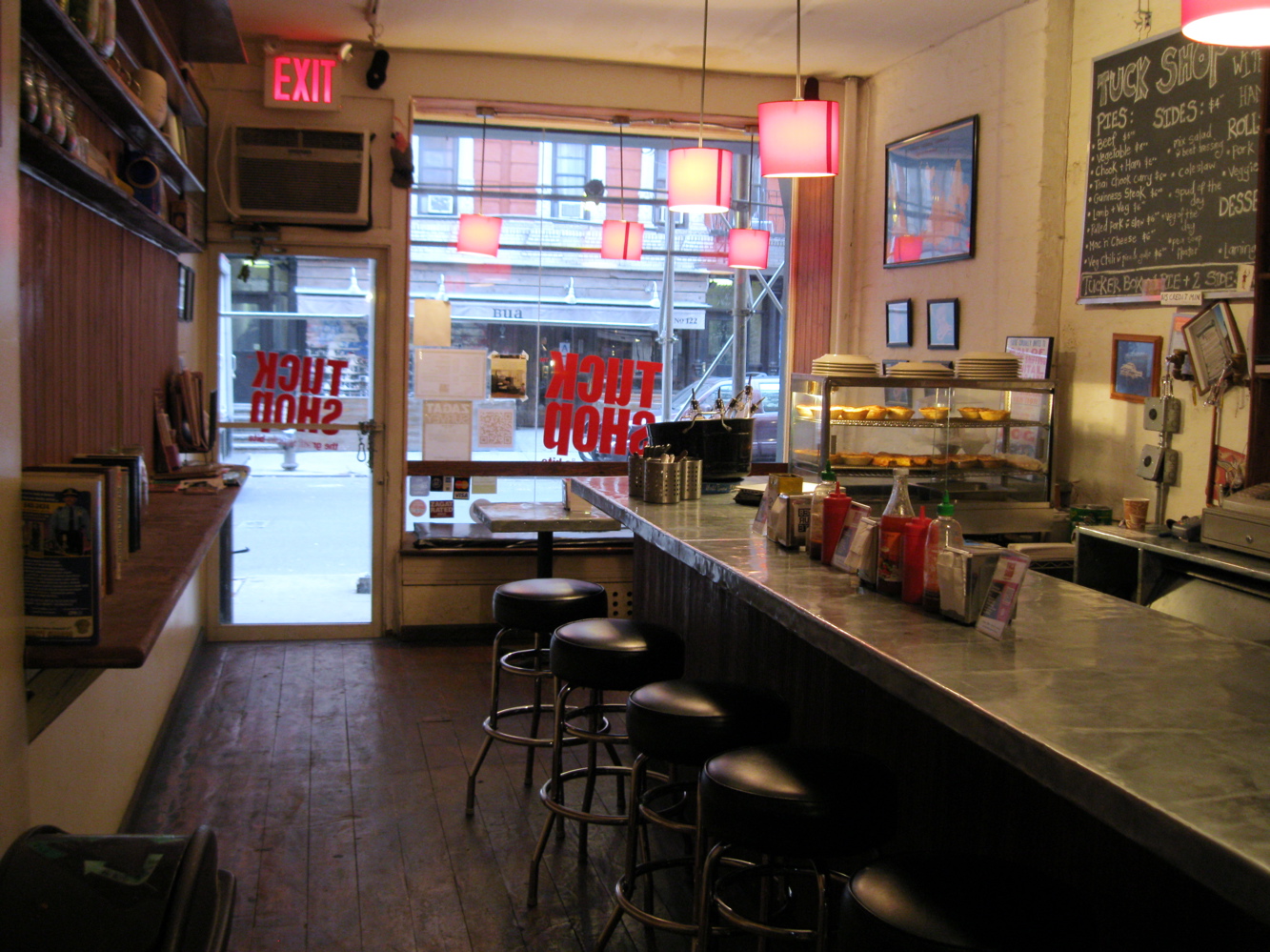
It’s a little shop with just a couple of tables and a counter with five stools, because most people follow Australian tradition and eat hand pies while on foot. Still, it’s cozy and festooned with the things you find in every Australian home, like a cricket bat, a boomerang, and a calendar showing all the pubs in Melbourne.

The hot pies are on view in a pie case and described in chalk on a blackboard. They were served on my visit by a genial Australian counter man named Isaac. I discussed my options with Isaac at length, learning in the process that chook means chicken, as in — per Isaac’s example — “Put the chook in the oven, love.”

Pull up a stool to dine in New York at Tuck Shop
St. Mark's Place.
Still, I declined the Thai Chook Curry pie, choosing instead the Traditional Beef pie and the Lamb and Veg pie, two of the most popular selections. They were both hot and piquant and satisfying enough to make a fine meal for $12. Isaac was impressed that I ate both.

Later I stopped at the First Street store, which is similar to the St. Mark’s store except that it has the table on which the pies are made and two inflatable kangaroos. It also had an Australian named Lincoln Davies, who owns the stores, even though he came to America to do the opposite of work.

“I came here with the idea of a two-week holiday,” he told me. But he couldn’t help noticing that America was dangerously short on meat pies. He made it his mission to help us out. A few years later he and his partner, Niall Grant, were running the first Tuck Shop, daringly free of auto parts.

Patrons enjoy no frills meat pies at Tuck Shop in New York City
East First Street.
Like all attempts to change eating habits, it has had challenges, Lincoln said: “ ‘Meat pie’ to an American conjures up nothing like this.” New Yorkers see ‘pie’ at a takeout and expect to have pizza pie. Anglophiles know English pies, which Lincoln refers to as “gelatinous.”

Australians, however, know their continent’s mass-produced gas-station pies, and so tend to regard the Tuck Shop offerings as gourmet fare. One such Australian was in the First Street store eyeing Lincoln and me as we talked. Lincoln was underselling his product, the man finally complained.

“In Australia, eating meat pies is something you do very casually,” said the Australian, Peter Freudenberger. “It’s not a fine dining thing. This place replicates the experience, but you get good food. In eighteen years in Australia I never saw a pie being made — just like you never see a hot dog being made here.”

Lincoln accepted the compliment. But the meat pie, he said, still battles — even after people have come in, tried it, and liked it. “Once they try them,” he said, “they get stuck on one, and we have to kind of wean them off it and get them to try another.”

Cooks in the back stretch dough for meat pies at Tuck Shop in New York City

Try another at Tuck Shop, at 68 East First Street, 115 St. Marks Place, and Chelsea Market Ninth Avenue, New York City.

Sunday, July 31, 2011

Gem Spa: A Sweet Sip of a Long-Lost City

”Gem
The egg cream is above the awning. The owner prefers no indoor photography.
By Mitch Broder

The awning at Gem Spa says “New York’s Best Egg Cream,” so let’s just take a moment here to get a few things straight.

New York’s Best Egg Cream was made by my grandmother.

New York’s Second Best Egg Cream is made by my mother.

New York’s Third Best Egg Cream is made by me.

I assume that Gem Spa had no room on its awning for “Fourth.”

Then again, my grandmother’s gone, my mother’s quit the kitchen, and I’m too shiftless to make anything, so the place could have a point.

If New York City had an official drink, it would probably be the coconut-water melon-smoothie latte. But last century, it would have been the egg cream. The egg cream is vintage New York not only because it made its name here, but also because its name consists of two things that aren’t in it.

”Gem
My old seltzer bottles with old seltzer. Do not drink.
An egg cream is created by mixing Fox’s U-bet chocolate syrup, whole milk, and pressurized seltzer. The operative word is “mixing.” The correct ingredients are critical, but so is the correct hand. If you don’t know what you’re doing, you might as well guzzle a Yoo-hoo.

That’s why it is near futile to anoint a place for its egg cream. It’s not a place that makes it, it’s a person, and persons vary. And a person’s work may vary with intangible factors, like time of day, mood, and temperament. Unless the person was my grandmother.

The best egg cream I remember getting on the Lower East Side was at an egg cream booth at the corner of Orchard and Grand. It was called Dave’s. It was run by Dave. The egg creams were made by Dave. Egg creams were a living for Dave. And he probably learned from my grandmother.

There are no more egg cream booths, and if there were they wouldn’t give you a free pretzel rod like Dave. That’s what makes Gem Spa precious: It’s the closest thing we have left. It may look like the Burma Bazaar, but it embraces the lore of the egg cream, and it mixes you one from a little fountain in the middle of the checkout counter.

Gem Spa is like an egg cream in that no one seems to know how it started. Sources suggest that it was born as a candy store in the twenties. Reportedly, two men bought it in 1957 and named it Gems Spa. “Gems” was from family initials. “Spa” was a word they liked.

”Gem
My old Fox's U-bet, from the refrigerator. Do not eat.
Since the seventies, it has changed hands and looks several times (and dropped that S), but apparently the egg cream technique has been handed down. The current owner is Ray, who doesn’t like to publish even his first name because, he says, he wants people to think of “Gem Spa,” and not of “Ray.”

“This is known to the whole country,” he says. “People come to drink our egg cream from Texas, California, Europe, everywhere. It’s in the visitors guides. People read about it and they come. And once they have the egg cream, they have to come back and have it again.”

Once there, they can also have other traditional Lower East Side confections, like Joyva Marshmallow Twists, Jell Rings, and Halvah. And they can stock up on newspapers, magazines, cigarette lighters, birthday candles, dominoes, Chiclets, mood rings, safety pins, bobby pins, scarves, sunglasses, and hats.

The egg creams come in four flavors, though an egg cream should be chocolate. They come in a paper cup, though an egg cream is best in a glass. They can come with a pretzel rod, though that will cost you extra. They can be close to perfect, though they can sometimes be  less close.

As to the origin of the egg cream and its name, we will never know. Theories and claims abound, but there is no way to prove them.

Some say one Louis Auster  invented it. Ray says Gem Spa invented it.

I say my grandmother invented it.

There’s no way to prove she didn’t...

Mix it up at Gem Spa, 131 Second Avenue, at St. Mark’s Place, in Manhattan.

Wednesday, June 29, 2011

Strangely New York: If You're Serious About Ice Cream, Get in Line


By Mitch Broder

This space is too stark and forbidding even for a bank, so there’s just one thing it could possibly be:

A fashionable ice-cream parlor.

Note the spartan décor, meant to stimulate prompt product-selection. Note the copious lighting, meant to ensure efficient purchase-delivery. Note the grave atmosphere, meant to convey critical brand importance. Note the cop, meant to discourage any random escape of emotion.

For in fact, this is not an ice-cream parlor. It’s a gelato lab. It’s Il Laboratorio del Gelato, the nerve center of creamology. Step in, order, eat and leave, or better yet, leave and eat. If you eat in, you’ll be standing up or sitting on a slab of steel, and that’ll teach you.

OK, I’m done. I’m not here to knock a man’s business, and besides, sarcasm’s exhausting. The truth is, online reviews suggest that the desserts here are delicious. I just couldn’t eat any, because as soon as I walked in I felt more depressed than I ever had in a store created for pleasure.

I get the lab concept. Making such great ice cream is a science. On Ludlow Street you can look through the window and watch the scientists work. The window says that you might see them peel peaches, pit mangoes, core pineapples, juice lemons, roast pistachios, or wrinkle prunes. I made that last one up.

But inside, it’s antispetic. I thought someone would come take my blood. It made Baskin-Robbins feel cheerful, and that takes diligent grimness planning. As people stepped up to the counter I thought of the Soup Nazi stand in “Seinfeld.”
Maybe that’s why I didn’t order: No sorbet for you!

As usual, I’m out of touch. This place is clearly popular. It was on Orchard Street for years, and this new store is much bigger. The clinical motif dovetails with the digital life, yet has the bonus of old-fashioned marketing strategy: Ice cream from a laboratory must be good for you.

But I still say the joint is bleak. Not to mention pricey. A small serving is $4.25, a large is $6.75, and so is a milkshake or an ice-cream soda. If you’re ever on Long Island, visit my idea of an ice-cream parlor — Krisch’s, in Massapequa, which is where Seinfeld grew up, which may be ironic.

Meanwhile, absolutely step into the lab. After all, it was founded by the same guy who founded Ciao Bella. It has 200 flavors (not at once), and I’m sure they really are delicious. They need to be, if they’re going to lift the despair you fell into when you walked in.

Experiment at Il Laboratorio del Gelato, 188 Ludlow Street, at East Houston Street, in Manhattan.

Wednesday, June 22, 2011

Strangely New York: Will Masala Twist Be the Next Kung Fu Bing?

The new Masala Twist.

By Mitch Broder

If you miss having bings in a toilet, go and have kababs in the same toilet.

The Chinese pancakes are gone, but the urinal seats live on.

The late Kung Fu Bing.
A month ago I wrote of the demise of Kung Fu Bing, a Chinese fast-food restaurant on the Lower East Side. It had hoped to do for the bing, or pancake, what hamburgers did for the bun. It didn’t succeed. It failed first in Chinatown, which is like the latke failing in Borough Park.

It was gone so fast that I didn’t have a chance to eat a bing, though based on review words like “gummy” and “greasy,” I would have been a fan. But I was more fascinated by its seats, shiny white bowls on conical pedestals, which bore an uncanny resemblance to a modern male relief station.

More important, they looked uncomfortable, a condition that’s clearly trending in the gimmick-grounded fast-food joints that seem to open here hourly. I suggested that the plastic chairs played at least a subliminal role in the death of Kung Fu Bing. I praised New Yorkers for their refinement.

The Toto Toilets Model UT104E#01. 
But no sooner did I post than Kung Fu Bing was replaced by an Indian fast-food restaurant called Masala Twist. The owners, of course, changed the menu. They changed the signs. They changed the décor. Sort of. But they kept the seats. I reacted rationally. I took it as a personal attack.

Though it may be thrifty, it seems imprudent to furnish a fledgling restaurant with conspicuous reminders of a conspicuous predecessor that flopped. Twice. And it still seems imprudent to me to invite people to eat on things that evoke the opposite of eating. I will never give up.

Masala Twist has a compact menu with economical selections like Chicken Tikka, Shami Kabab, and Eggplant Masala. I think it hopes to do for masala, or spices, what Kung Fu Bing didn’t do for the bing. Its Web site suggests that they’d like you to refer to the store as “Twisty,” which I believe is Indian for “Mickey D’s.”

The Web site also says: “When you eat at Masala Twist, it is just like eating at households throughout India.” I have not eaten at households throughout India. But I’ll just bet that the residents don’t take their meals on leftover Chinese-pancake seats that look like they belong behind a door marked “Men.”


Size up the seating at Masala Twist, 189 East Houston Street, between Orchard and Ludlow streets, in Manhattan.

Sunday, April 24, 2011

Katz's Delicatessen: NYC's Oldest Deli Meets NYC's Newest Blog

Katz’s Delicatessen New York City Lower East Side Vintage Destination
By Mitch Broder

This month, I have learned, the world-famous Katz’s Delicatessen on the Lower East Side of Manhattan is launching a brand-new slogan.

The old slogan was “A Delicatessen For 122 Years.”

The new slogan is “A Delicatessen For 123 Years.”

I have picked this milestone as the occasion on which to launch my brand-new blog. You can count on me to bring you this sort of breaking news yearly.

Actually, I was already planning to launch the blog this month, because I had originally planned to launch the blog last month. But I am happy to share my debut with Katz’s Delicatessen’s slogan, because Katz’s is the perfect example of what I’m launching for.

It’s a New York City haunt that’s old but beguiling. It’s a place that takes you back in time and makes you want to stay. It’s a revelation not just to tourists but to procrastinatory New Yorkers. It’s a landmark that you think will always be there — but might not.

Katz’s Delicatessen New York City Lower East Side Interior
Katz’s is a roisterous emporium where people go to eat pastrami in peace. Everyone else is eating it, so everyone can eat it without guilt. Along with the pastrami, Katz’s has hot dogs, corned beef, brisket, salami, and other delicacies that have long fueled hardy Eastern European Jews.

 Katz’s Delicatessen New York City Lower East Side Lunch Receipt
My ticket curled up at the
bottom because it fell
into the sauerkraut.

It is very exclusive. You need a ticket to get in. A man hands you one, and signs warn you of a fifty-dollar fine if you lose it. Katz’s has both waiter and cafeteria-style service; all purchases are marked on the ticket. If there’s a better system, they haven’t found it.

The roisterousness and the tickets are among the reasons why I used to begin my visits to Katz’s with an anxiety attack. But now I swagger in, secure that I am fully capable of ordering two frankfurters and a knish and finding a seat. Katz’s builds character.

I swaggered through lunch, after which I was joined at my table by Alan Dell, whose slogan is “A Katz’s Owner for 25 Years.” Alan is often on the floor, chatting with the regular customers, and he’s always on the walls, in photos of him with the famous customers.

Katz’s Delicatessen New York City Lower East Side Neon Sign
He reminded me that Katz’s has two other slogans.

One is “Send a Salami to Your Boy in the Army,” coined during World War II. The other is “That’s all,” coined by a sign painter. Grandpa Katz, Alan says, ordered a sign for the store. The painter asked what he wanted on it. A testy Grandpa said: “Katz’s, that’s all!” That’s what the painter painted.

Yet somehow I remain fondest of “A Delicatessen for 123 Years.” So I’ve decided to steal it. Mitch Broder’s Vintage New York: “A Blog for One Day.”

Join me as I explore the things that make Manhattan vintage. I am confident that, together, we can make my slogan change, too.

Discover Katz’s Delicatessen at 205 East Houston Street, at Ludlow Street, in Manhattan.