Showing posts with label Times Square. Show all posts

Thursday, June 28, 2012

Strangely New York: We Have the Best Summer Travel Bargains

Climbing the Swiss Alps aboard the New York City subway system
By Mitch Broder

While others were spending thousands to vacation in the Rockies, I was spending $2.25 to vacation in the Alps.

It was a surprise vacation, which made it all the merrier. I simply boarded the Times Square Shuttle and I was just feet from happy hikers. Two of the hikers were hiking right onto the subway seats. I think that's allowed whenever a mountain range uses mass transit.

Get lost in a trip to Switzerland aboard these New in New York billboards on the subway


I believe that the shuttle takeover was Switzerland's neutral way of enticing me to go to the Alps. But I like that they came to me. I enjoyed the fresh Alpine air during my entire trip across 42nd Street. Naturally, I snapped a couple of pictures to share with less-fortunate friends.


Find yourself transported to Switzerland with this Strangely New York subway billboards


Switzerland has left the benches, but my vast train-trotting experience tells me that some other destination will be arriving soon on Track 3. My advice is to be prepared. Always carry a loaded MetroCard. And wear comfortable clothes. Your vacation can take as long as two minutes.


Subliminal messages painted by the MTA on the platform of a New York Subway reads Go Forth


Needless to say, the MTA wants me to travel. Why else it would it paint subliminal messages all over its subway stations? But it would surely prefer that I spend my tourism dollars in New York, which is why I applaud it for bringing the rest of the world here, where I can afford it.

Watch yourself so you don't get trampled by these Strangely New York billboards promoting Switzerland on your subeway ride


Have a nice time, and don't get trampled.

Wednesday, May 30, 2012

Old New York: Catherine Russell's Devoted to Her Life of 'Crime'

Catherine Russell and Richard Shoberg star in the Old New York production of Perfect Crime
By Mitch Broder

“Perfect Crime” has been running for 25 years, which might seem like a trivial feat if, say, the same person had been starring in it for 25 years.

Which she has.

Tough break. But a play’s a play. It could run forever and not get crabby. A person’s a person, and most persons can’t play another person 10,000 times. So it’s no surprise that the “Perfect Crime” star holds the Guinness record for Most Performances of a Theatre Actor in the Same Role.

Which she broke four years ago.

Catherine Russell created Margaret Thorne Brent in 1987 and has kept her alive since then in every scheduled performance but four. She missed three to go to her brother’s wedding and one to go to her sister’s wedding. She was supposed to miss two but her understudy got sick and Catherine was the understudy for the understudy.

Catherine Russel answers the phone in the Old New York production of Perfect Crime
The photos of Catherine are courtesy of John Capo
 Public Relations. At the top, she's with Richard Shoberg.
Tonight she appeared in performance number 10,281 (though, for her, only performance number 10,277). If she were to repeat all of her performances in a row, she would be onstage for about two and a half years, and she would probably do it without a lunch break.

There are eight performances a week, so, naturally, Catherine sees the job as part-time. She also teaches English at Baruch College, teaches acting at NYU, gives acting lessons at the theater, and manages the theater. In her time off, she appears in other plays and in movies. And every Sunday she goes to church.

The schedule may sound unnatural, but Catherine makes it sound the opposite: She wants to act, teach, and manage, so she acts, teaches, and manages. “I like what I do,” she told me. “I say to my students … ‘I’m happy being here with you.’ That’s why I think I don’t get sick. People are prone to getting sick when they’re unhappy.”

I accepted an invitation to see ‘Perfect Crime’ on its anniversary, even though it meant that I couldn’t get my money back if Catherine didn’t show. I had never seen it. Maybe it’s because it has moved eight times and I couldn’t keep up, which, as it turned out, I also couldn’t do when I saw it.

“Perfect Crime,” by Warren Manzi, is a murder mystery, which portrays a murder, or not, at its start, which is when I fell behind. I admit this not because I’m honest but because I’m not alone. The theater has printed a flier with answers to 17 plot questions, which was obviously put together for people besides me. Or not.

On the set of the Old New York theater performance of Perfect Crime
But I didn’t care. The plot can be a challenging diversion, but Catherine is the show. She owns the stage. And she looks really good in black. I found myself so fixed on her performance that, by the end of the play, I didn’t even have any questions, let alone any answers.

This was notable because Margaret Brent is not someone I’d need to meet. She is a therapist who could benefit from anger management therapy. She is in your face all the time and does many unpleasant things, and yet you like her. It’s just like being with a real person.

Still, that person is never quite as fascinating as Catherine Russell. After a nice chat I still couldn’t figure out how she’s played that part so long. She said that she never approaches her  performance as if it’s just a job. Yet she can dash from the box office to the stage at show time as if it’s just a job.

The view outside the theater of the Old New York show Perfect Crime
But I did believe that, at least in her case, both are true. Catherine Russell is a person who does what has to be done.

When the play needed a home to stay alive, she not only built one but got Snapple to sponsor it, creating the Snapple Theater Center. When the center needed another tenant, she got “The Fantasticks,” creating a single stop for the world’s longest-running musical and New York’s longest-running play.

“I’m lucky,” she said. “I’m blessed. When you’re lucky and blessed, you show up.” And that was what she had to do one day when I cluelessly called close to curtain.

Yet even then she was polite. She took the call to tell me herself.

“I’m gonna go shoot somebody now,” she said sweetly. “I’ll be thinking of you.”

Actress and World Record Holder Cahterine Russell stars in the Old New York production of Perfect Crime since 1987

Catch Catherine in “Perfect Crime” at the Snapple Theater Center, 1627 Broadway, at 50th Street, in New York City.

Tuesday, April 3, 2012

New in New York: At Hello Deli, Rupert's Finally Got the Goods

Hello Deli is not New in New York, but Rupert as a tshirt and hat salesman is

By Mitch Broder

The best way to meet a beloved late-night TV star is to ambush him while he’s selling a cup of meatball-and-spinach soup.

But then, this is intuitive to New York City tourists, who meet such a star every day by bounding into his delicatessen.
Tourists in New York City pose with this Old New York deli owner.

The star, of course, is Rupert Jee, who, against Mega Millions odds, became a household name in comedy while running a sandwich shop. He took over the shop, Hello Deli, in 1992. The next year, “Late Show with David Letterman” moved into his building and drafted him.

He has since made dozens of improbable appearances on the show, while, with his deli partner, May Chin, remaining a humble proprietor. And lately, along with the air time, he has been entrusted by his network with the “Late Show with David Letterman” souvenir-stuff stand.

Meatball-and-spinach soup has given way to tshirts and hats at this New in New York souvenier shop for Rupert Jee
The stuff used to be sold at the nearby CBS Store, but CBS closed the store, which has become a meat-pie shop. The network offered the “Late Show” merchandise to the likeliest neighbor. So now Rupert has T-shirts, caps, and mugs where his soda fridges used to be.

The stuff attracts more business, which means it attracts more fans. People sweep in all day and greet Rupert as if he’s their best friend. They tell him what they’ve seen in New York and then make him pose for pictures. It’s a wonder he has time to make sandwiches, let alone meatball-and-spinach soup.

The Hello Deli has now become the defacto gift shop for the Late Show with David Letterman“It’s almost like a broken record,” he acknowledged. “They ask the same redundant questions. ‘Do you hang with Dave?’ ‘How long have you been on the show?’ ‘What are your favorite moments?’ ‘What’s Dave like?’” He had just finished acknowledging this when a woman from Toronto swept in and said: “Can I take a picture of you, famous man?” She wasn’t talking to me.

Fortunately for everyone, Rupert’s the picture of composure. He is every bit as accommodating as he seems on TV.  He appears to have limitless patience, unless it’s just resignation. When you meet a celebrity, you dream that he’ll treat you the way Rupert does.

One would never guess that the Hello Deli would be a staple of comedy in America, but this New York city staple is now truly famous.He is nice because he’s doing what he really wants to do, which is to run a delicatessen, not to be a TV star. And he’s nice because being a TV star turned out to be fun anyway, and he recognizes that such fun comes with a measure of compromise.

The fun began soon after “Late Show” premiered in August of ’93, when Dave decided to introduce the nation to some of his neighbors. “I was just too scared to be in front of an audience, so I told the writers not to come in,” Rupert recalled. “Of course, they went against my wishes.

“Six weeks into the show, they brought the cameras in without any warning. Dave interviewed me here first, and then he said: ‘I want to do something special for you, something you’ll remember for the rest of your life.’ So he brought me onstage for a standing ovation. An undeserved standing ovation.”

Or maybe not. Rupert’s good nature made him the perfect character to execute some of the show’s more perilous comedy concepts. In one famous piece, Dave sent him out as a dimwitted waiter and fed him lines designed to drive diners to profanity — which they did.

Rupert Jee of the Hello Deli embraces his stardom at the New In New York souvenier shop
Though he’s on the show a little less often, his fame is undiminished. “But I’ve always carried a simple philosophy in life,” he told me. “If something happens to you, you don’t take it for granted. If people come in every day for pictures and autographs, you just remind yourself that it could have been a lot worse.”
In fact, sometimes he’s on the show even when he’s not on it, which turns out to be every bit as good for business.

“Dave said on the show that if you come in to Hello Deli to purchase ‘Late Show’ merchandise, it’ll smell like salami,” Rupert explained. “Whatever he says sells. That’s the power of television. He called this place a dump one day and, needless to say, the next day the place went crazy. They came to see the dump.”

A sandwich and a tshirt please, at the Hello Deli, deli and tshirt stand.

Get a snack from a star at Hello Deli, 213 West 53rd Street, between Broadway and Eighth Avenue, in New York City.

Wednesday, March 21, 2012

Old New York: Find the Ficoseccos at the Accordion Museum

The Accordian Museum certainly has an Old New York feel to it.

By Mitch Broder

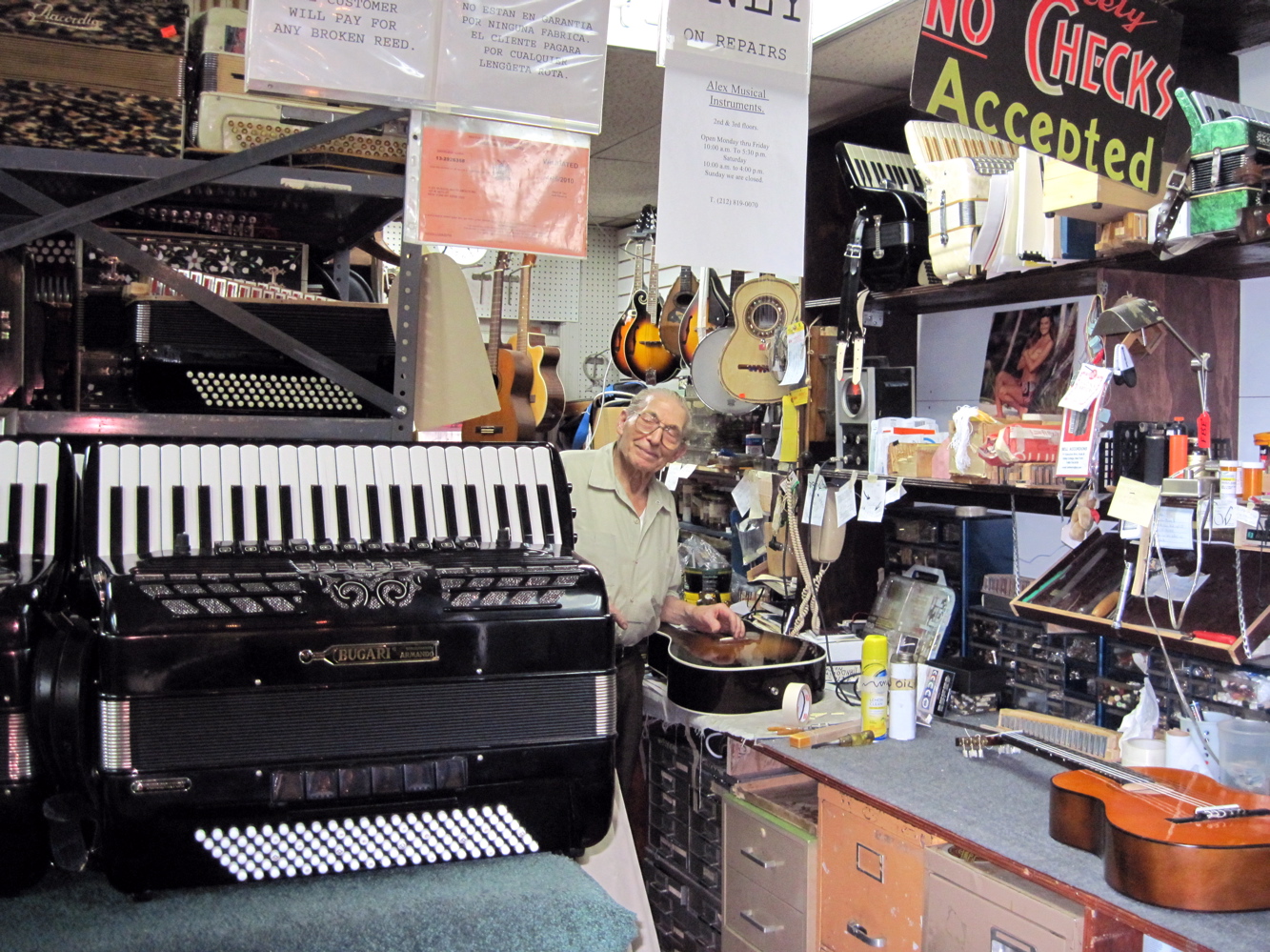
To be honest, I was mostly looking at the twin bejeweled mermaids, but Alex guided my attention to the instrument they festooned.

It was the E. Galizi Bro. White-and-Gold Pearled Piano Accordion, which is kept locked up in a case, which is kept locked up in a room. “This was made here in New York, in the 1920s,” Alex said. “I keep it here. I never touch it. But you gotta hear this.”

The E. Galizi Bro. White-and-Gold Pearled Piano Accordion is under lock and key at the Old New York Accordian MuseumHe lifted the squeezebox, sat down, and played “Under Paris Skies.” It was glorious, and French songs normally make me queasy. In his expressive Italian accent, Alex offered a cogent explanation for my redemption: “Make music on this was like make gold.”

Cases and cases of squeezeboxes adorn the Accordian Museum
If so, he’s in a gold mine, for he walks among the accordions, many of which are treasures like the one from the Galizi brothers. Alex is Alessandro Carozza, New York City’s Accordion King and the owner and curator of New York City’s Accordion Museum.

It is part of his two-floor accordion complex, in which he buys, sells, repairs, and otherwise attends to a century or so’s worth of accordions. He loves to show off his museum, because he loves his museum, because moving his accordions there from his apartment kept his wife from killing him.

He showed me his little red Hohner model from 1945. “It’s funny, but no joke,” he said. “It’s a real accordion.” He showed me his big black Pasquale Ficosecco model from 1921. He has accordions from three Pasquale Ficoseccos, including the one who still works at the store.

The curator of the Old New York Accordian Museum is happy to start a jam session for you

He left me to take care of some customers and locked me into the room. I felt secure, knowing that I finally had enough time to learn how to play. I always wanted to play the accordion because I wanted to push all those buttons. But I now know that accordions are serious instruments, though I’m still not sure about that red one.

Accordian enthusiasts will find a mirade of classic accordians at this Old New York landmark

I admired the 1927 Excelsior, the 1910 Paolo Soprini, the 1906 Beaver Brand. I admired the rhinestones, the sparkles, the silver lace, the gold mesh, and, needless to say, the mermaids. I found all of the accordions in the museum fascinating — and yet not quite as fascinating as their king.

When he let me out, I learned that Alex was born in Italy and grew up in Argentina, where he mastered the accordion trade. “I came here with four hundred dollars in my pocket when I get off the plane,” he told me. “No English — just Italian and Spanish.”

But he went to NYU and had a career as a documentary filmmaker, while moonlighting as accordionist for a group called Alejandro y Los Internacionales. “We brought Latin jazz to America,” he said. “Then they came out with the boogaloo. Everybody went crazy with the boogaloo.”

An accordian player can even get his-her instrument repaired by the curator at the Accordian Museum.
Can you find Pasquale Ficosecco?
When he got tired of lugging cameras, he joined a store called Accordion-O-Rama (which at the time was New York’s accordion place but has since moved to New Jersey). Then he moved to Music Row, where he became manager of the Sam Ash store. He opened his own repair shop forty years ago and then his own store across the street.

That store, Alex Music, made him rich and famous, he says, and led to an offer to be the president of the Gibson Guitar Corp. He considered that a high honor. He turned it down. He didn’t want to be a chief executive. He just wanted his accordions.

So twenty years ago he gave up the big store and opened his little store, one floor below his original repair shop. A few years later, he added the museum, to help preserve accordion history. You get in by making an appointment. There’s no guarantee you’ll get out.

Alex, of course, could retire. Instead, he buys accordions by the hundreds and sells them at $1,000 to $15,000 a pop. His place is a mecca for many of the great accordionists of the world. And that, he told me, is the reason that he doesn’t retire.

“Can I tell you something?” he said. “They don’t let me — the professionals. They need me, and I have to do it. They come from so far. From New Zealand, they come over here to fix accordion. They say, ‘Don’t die, Alex, ’cause if you die, we don’t play anymore.’”

Classic accordians abound at the Old New York landmark, the Alex Accordian Museum border=

Take your squeeze to the Alex Accordion Museum, 165 West 48th Street, between Sixth and Seventh avenues, New York City. 

Wednesday, February 29, 2012

New in New York: Watch Your Lip at Pie Face

Smiling meat pies welcome you at the New in New York restaurant Pie Face

By Mitch Broder

I only eat things that aren’t smiling at me, which leaves most of my friends at risk, but I made an exception for a pie. Still, it was tough to stick a fork in its face.

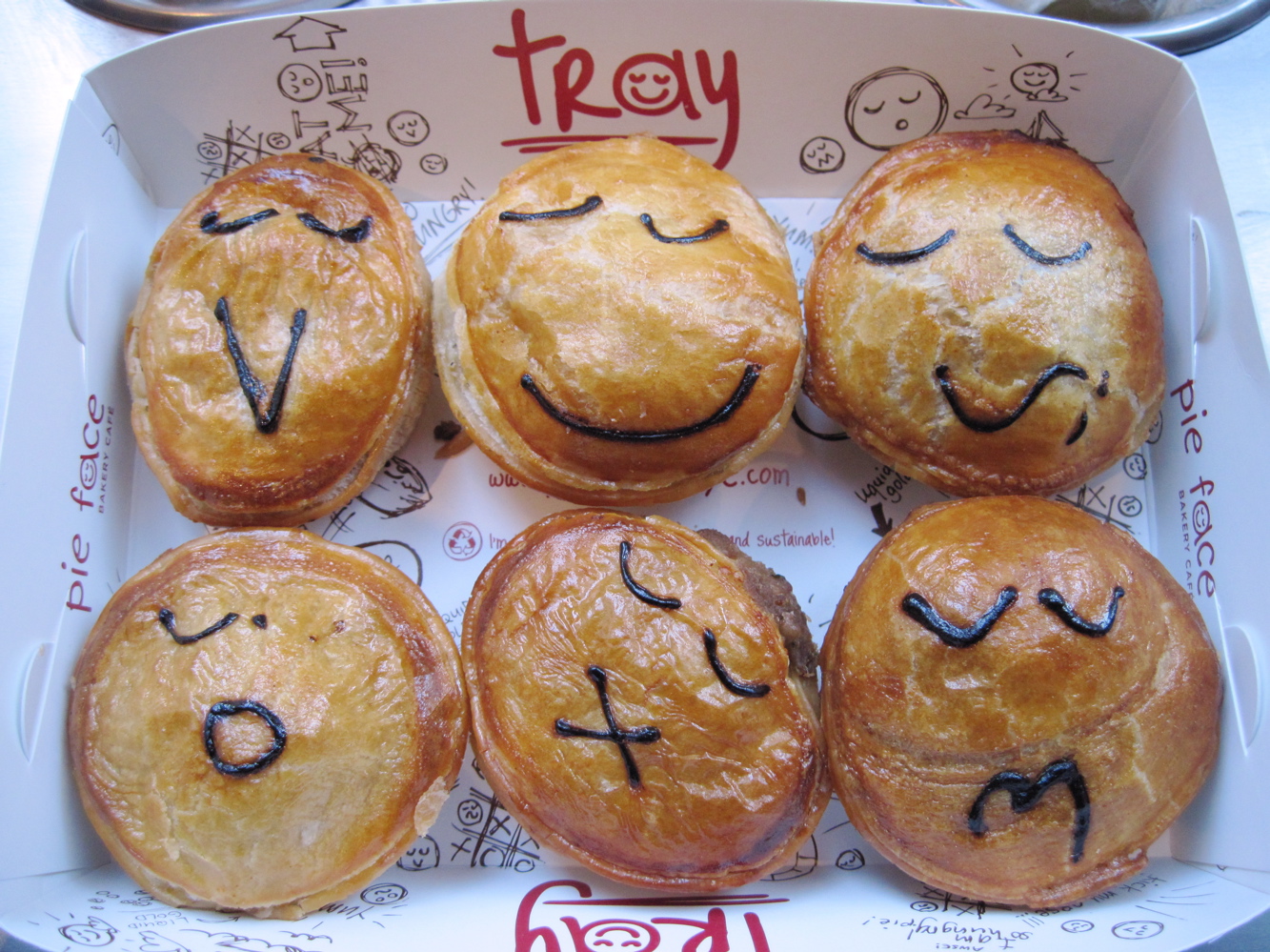
I actually ate most of six pies, all of which had faces, because they were the pies of New York’s first Pie Face Bakery Café. Pie Face is the Australian fast-food chain founded on the reasonable premise that meat pies that can upstage fashion models must have a global future.

Catch a glimpse of the Ed Sullivan theater right around the corner from the New in New York Pie Face

New York’s first Pie Face is on Broadway at 53rd Street, and it has people lining up daily for its expressive pastries. This is partly because it faces the people lining up to see David Letterman, but also because it has pie that you can justify as food.

The idea is not new in Australia, where meat pies sell like hot cakes, and where Pie Face already sells them in seventy jolly stores. It’s also not new in New York, which has for a while had Tuck Shop, which I wrote about when I thought it would be my one meat-pie post for the season.

But Tuck Shop is proud to have grown from one store to three in seven years, while Pie Face has the unmistakable look of an aspiring hand-food empire. It plans to turn New York into Pie City before turning America into pie country, its emotional crusts vanquishing our impassive burger buns.

A full tray of meat pies with unique faces artfully displayed by the artists of Pie Face a new in new york restaurant


I almost believed it could happen after a representative named Colbern Uhl presented me with a tray of six fresh hot Mini Pies. Not all of them were smiling, and one was missing an eye, but they were all delicious, including the ones I would never have ordered if I’d had to pay.

The pies’ various fillings are identified by their various mouths, which is why only one has the trademark smile, since the smile is also a C. The C identifies the Chicken & Mushroom Pie, which tastes like the one meat pie Americans embrace, which is chicken pot pie. If you’re intransigent, get that.

A Pie Face cook splashes on the egg wash that gives the meat pies their signature look
Kevin Nieves, the store manager, egg-washes your pie.
If not, try the S mouth, the Chunky Steak Pie, which tastes like chicken pot pie would taste if it were steak pot pie. It’s the most popular. Or try the M mouth, the Mince Beef & Tomato Pie, which is said to taste like shepherd’s pie but which I thought tasted like pizza pie.

The X mouth is the Mexican Pie, since the M was already taken. I expected it to be spicy, perhaps because it has jalapeño. But it wasn’t. The spiciest pie was the Tandoori Vegetable Pie, and even that wasn’t very spicy. It has a V mouth because a T doesn’t make a good mouth.

Unbaked pies at Pie Face await people looking for a yummy treat when dining in New YorkThe O mouth is the special, which is currently the Thai Chicken Curry Pie, which like the others that sounded spicy is instead mild yet flavorful. I asked Colbern why its mouth is an O. “It’s saying, ‘Wow! I’m the special!’” she explained. “They talk?” I asked. “They talk,” she said. “If you want them to.”

Apparently, some customers would want them to, so that the pies could explain themselves. Colbern said that patrons are often baffled by savory pies. “They like them ’cause they’re smiling at them. But they want to know what a meat pie is. Once they have one, though, they come back for more.”


That’s what Wayne Homschek and Betty Fong discovered as the creators of the Australian fashion label Paablo Nevada. At a show, they thought it would be ironic to serve lowly meat pies with their high fashion. It was ironic. The crowd got more excited by the pies than by the fashion.

So the clothing designers became meat-pie entrepreneurs, taking branding inspiration from a smile face someone drew on a napkin. As an incidental irony, “pie-faced” is not exactly a compliment. But this is clearly the restaurant chain that could turn that around.

It's not just about Pie Face meat pies, the shop also has soups and sandwiches for ever palate of person dining in New YorkAlong with the Mini Pies, Pie Face has regular pies, and along with the savory pies, it has sweet pies. The apple has an A mouth, the blueberry has a B mouth, and the cherry has a C mouth. Still, no one confuses it with chicken & mushroom.

The shop has soups, sandwiches, and sausage rolls, and coffee coded with scary faces. And it has stacks, which are meat pies topped with mashed potatoes, gravy, and peas. What it doesn’t have is a place to sit. You can stand at a counter or eat walking. Pie Face wants you to have an authentic Australian experience.

To that end, it also has an authentic Australian dessert called a lamington. It’s cubic sponge cake filled with raspberry jam and coated with chocolate and coconut.

I didn’t try it, since I ate six pies. And it doesn’t seem to be heavily promoted.

Maybe it won’t be. Still, be prepared for New York’s first Cake Face.

No visit to Pie Face would be complete without a picture of tourists

Get your fill at Pie Face, 1691 Broadway, at 53rd Street, in New York City.

Tuesday, February 21, 2012

Old New York: "The Fantasticks" Makes Long-Runs Look Short

The Old New York stage show The Fantasticks


By Mitch Broder

“The Fantasticks” seemed like a show you could count on seeing once a decade, so imagine my disappointment when it closed in its forty-second year.

A couple of the actors in the old New York production of the Fantastics
Cast photos courtesy of John Capo Public Relations. 
Sure, it outlasted losers like “The Sound of Music,” which opened in the same season yet closed forty-nine years ago. Then again, “The Fantasticks” didn’t have any Nazis. And indeed, it did come back. Though it closed in January of 2002, it reopened in August of 2006, and just like old times, it’s still running.

It has thus played for forty-seven years if you include the current run, and even if you don’t, its world record is foreseeably secure. This month, the longest-running Broadway show ever, “The Phantom of the Opera,” played its 10,000th performance. On its closing night, “The Fantasticks” played its 17,162nd performance.

“The Fantasticks” is Off-Broadway, but it’s still the longest-running musical in history. That alone, I decided, made it worth a fourth viewing. My third was on that closing night, when I had the distinction of getting out of F. Murray Abraham’s way so he could get to the stage to make a closing-night speech.

The original home for the old New York production of the Fantastics at the Sullivan Street Playhouse
Where the Playhouse was. 
The show’s original run was at the Sullivan Street Playhouse, in the West Village. The new run is at the Snapple Theater Center, or per the awning, the All Natural Snapple Theater Center. The center, though all natural, does not have the old-Greenwich Village charm. Then again, for Times Square, it’s as charming as it gets.

The show’s home, which is at the Center, is the Jerry Orbach Theater. Orbach was in the original cast. The lobby, fittingly, is a Museum of “The Fantasticks” and Jerry Orbach. It has posters from Broadway shows that starred Orbach, like “Chicago,” and from “Fantasticks” productions like one that starred Liza Minnelli in Connecticut.

The new home of the Old New York production of the Fantasticks is the Jerry Orbach Theater
The interior of the theater eerily resembles that of the Playhouse. I checked to make sure that I wasn’t blocking F. Murray Abraham. It has 199 seats, just over fifty more than before. It has the same tiny plank stage with the same white-sheet curtain. Maybe the exact same.

Everything is simple, for it is a show about simplicity, and the bonehead things everyone always does to complicate it. It’s a little love story, punctuated with tenacious burlesque humor and sprinkled with gentle, wistful songs that might be quaint but aren’t dated.

The set consists of six black poles, a bench, a chair, a box, and a trunk. The props consist of a watering can, shears, wooden sticks, and confetti. The cast consists of eight actors. The orchestra is a harp and a piano. The whole lot would fit in the chandelier at “The Phantom of the Opera.”

Characters from The Fantasticks perform in the stage production of the Old New York classic
The show opened with its tinkling overture, the fluttering rainbow confetti, and the actors introducing themselves to the audience. Luisa, aka The Girl, popped up to me and cheeped “Hello!” I cheeped hello back. Whenever I go to this show, I play a pivotal role.

My moment with The Girl would be the highlight, of course, but the show continued anyway, leading off with its most famous song, “Try to Remember.” The show proceeded as I remembered it, though maybe even more leisurely paced. A couple of those comedy scenes took enough time to do them twice.

But you don’t come to this theater to see falling chandeliers or dancing animals or flying spider-men or even flying nannies. You come to see a little show that opened on May 3, 1960, and hung on long enough to pay its investors a return of 20,000 percent.

The Fantasticks is narrated by this man
Most of the credit goes to the creators, Tom Jones and Harvey Schmidt, for whom this was a follow-up to a college musical called “Hipsy-Boo!” Ever devoted to his masterwork, Jones directed the current production and for a long time played The Old Actor — which he had played in the original cast.

But a musical needs more than its music to be running — even with a break — since the top salary in the major leagues was $80,000. “The Fantasticks” takes you back to simpler times yet remains timeless. Unlike that salary, which, if you’re wondering, was the take-home for Willie Mays.

My fourth visit took me back, though not as far as my first three. But I blame that on the girl next to me who kept texting in her purse. She was a rude reminder of digital antisocial behavior.

She wouldn’t have got away with that at the original show.

Eisenhower wouldn’t have stood for it.

Posing in front of the Fantasticks curtain

Try to relax at “The Fantasticks,” at the Snapple Theater Center, 210 West 50th Street, at Broadway, in New York City.

Tuesday, February 14, 2012

Old New York: Chez Napoléon Ducks the French-Food Canards

The New York City dining room of Chez Napoleon
By Mitch Broder

Broadway patrons have abandoned French restaurants for places like Steak ’n Shake and Shake Shack, because cheeseburgers, milk shakes, and fries don’t have all those rich sauces.

A classic red sauce simmers on the stove of the Old New York restaurant Chez Napoleon
It’s been tough on the bistros, if indiscernible to the bypass surgeons. But for the daring few who would gamble on comforting food in a comfortable place, there is still Chez Napoléon, which actually also serves fries, since, as we know, they are French.

It’s an increasingly rare New York outpost for brain, liver, and thymus, cleverly translated into Cervelle de Veau, Foie de Veau, and Ris de Veau. But it’s more than organs and glands. It has all the less-functional classics, like Boeuf Bourguignon, Canard à L’Orange, and Bouillabaisse (though that does have mussels).

Not only that, but the food is cooked in a cozy French kitchen, often by a cozy ninety-year-old French grandma.

Not only that, but the meals are served in two soothing dining rooms with soothing thematic accents like guns and battle scenes.

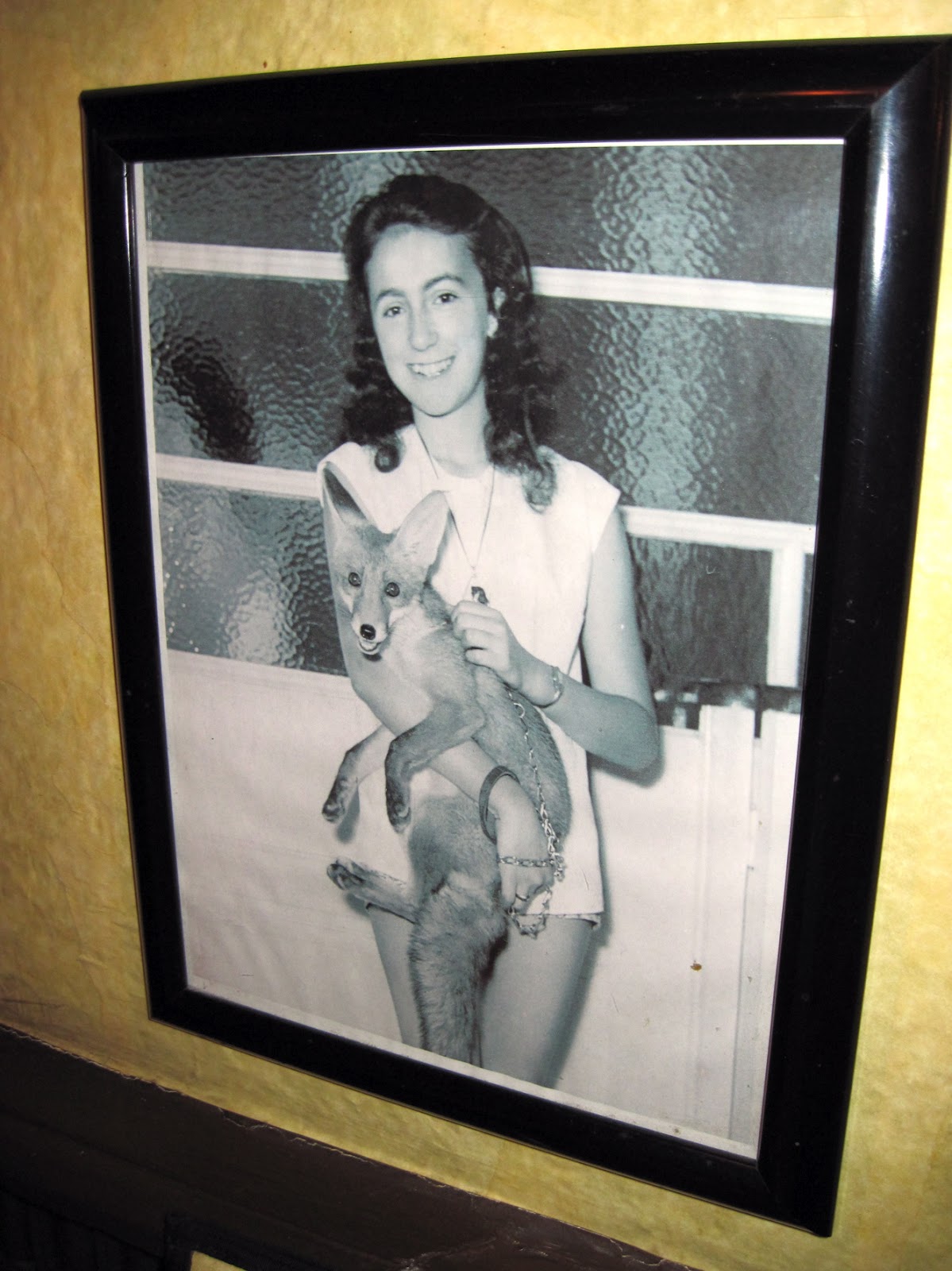
A photo of a young Elayne Bruno, owner of the Old New York restaurant Chez Napoleon
This is Elyane with a fox.
Not only that, but they have a jigsaw puzzle menu. Burger joints don’t even have a crossword puzzle menu.

Stirring this cassoulet is Elyane Bruno, who bought Chez Napoléon with her mother — the grandma chef — thirty years ago, when it was twenty-two. To celebrate the anniversary, she told me, she plans to do nothing. It’s that sort of prioritizing that keeps escargot alive in a nachos world.

The restaurant began as La Gérbe d’Or and became Chez Napoléon in 1960. It was not named for the emperor; it was named for the owner, who was nicknamed for the emperor. He was called Napoléon, according to the restaurant’s Web site, “due to his short stature and even shorter patience.”

Elayne's mother Marguerite helps to run Chez Napoleon
This is Marguerite with a cat.
The patience ran out in 1969, when he sold to a French couple, and the couple’s ran out in 1982, when they sold to Elyane. Elyane had been a waitress at Chez Napoléon, and before that at L’Esterel, her family’s first restaurant here. Working for your parents prepares you for anything.

Elyane’s father, Alfred, died in 1992, and as for her husband, she says: “I sent him back to France in 1985.” So she runs Chez Napoléon with her mother, Marguerite, who is known as Chef Grand-Mere, and her son, William Welles, who is known as the bartender and the creator of the jigsaw puzzle menu.

It is not a jigsaw puzzle of a menu. That would hamper turnover. It is a menu of French-themed jigsaw puzzles. It offers entrées like the 6,000-piece “The Coronation of Napoleon” ($80). Some of William’s finished puzzles are on the walls with the guns and battle scenes.

A framed jigsaw puzzle adorns the wall at the old New York restaurant Chez Napoleon
This is a jigsaw puzzle.
Despite this abundance, Chez Napoléon has had its own battles. When it opened, for instance, its neighbor was Madison Square Garden, until it moved away eight years later, taking all the gourmet boxing fans. For years, the Garden’s site was a giant parking lot, and American cars have always been snobby about eating French food.

Even worse, Americans became snobby about eating French food, probably around the time that Elyane took over the restaurant. “I think people have this idea that French food is too rich and too heavy,” she says. “But French people are not obese like here.”

The theater district, she says, once had many French restaurants, but now it’s down to a few. “Other restaurants opened,” she says. “Chinese, Japanese, Spanish, Mexican, so many different cuisines — what they call cuisine — so there’s more competition, and little by little they all disappeared.”
Signs notify patrons of what they can expect at the Old new York Chez Napoleon

She has lost office workers to office cafeterias, not to mention to shrinking lunch hours. And she has lost a little of everyone to the burger stands. But she still has regulars and she still has theatergoers, and she still has the place itself, as long as she doesn’t lose it to richer and heavier rent.

And she still has another attraction that you hardly ever see: a bar that invites you to sit down and drink by yourself. Its one stool is a rest spot for Chef Grand-Mere. But otherwise, Elyane says, it is the centerpiece of “the singles bar for people who want to stay single.”


One stool provides the perfect spot for a quick drink at the Old New York establishment Chez Napoleon

Shake off the shakes at Chez Napoléon, 365 West 50th Street, between Eighth and Ninth avenues, in New York City.

Wednesday, December 28, 2011

The Hourglass Tavern: Time Sifts When You're Having Fun

Dining in New York at the Hourglass Tavern is a unique experience.
By Mitch Broder

In Times Square, you can watch a ball drop until your year is gone.

Just blocks away, you can watch sand drop until your seat is gone.

Either way, something is gone. But in Times Square you could be cold and hungry, while just blocks away you could be warm and fed. Personally, I’d take warm and fed, meaning the Hourglass Tavern, the most hospitable place you can find in Manhattan to throw you out.

You're on the clock when dining in New York at the Hourglass Tavern
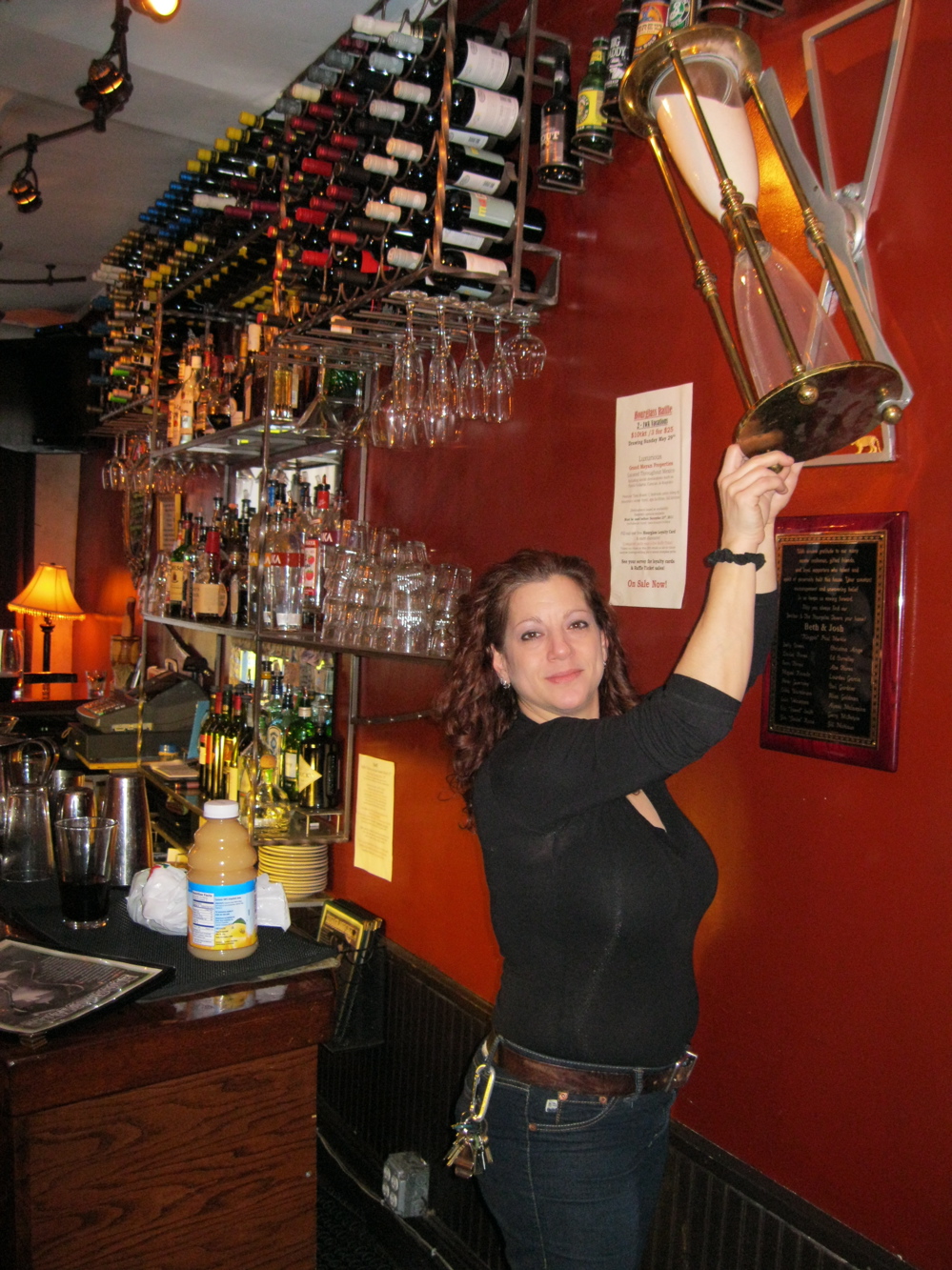
Beth setting the clock.
The Hourglass opened three decades ago on a reasonable premise: They had just a little space, so you had just a little time. There was an hourglass nearby at every table. When you sat down, it got flipped; when it ran out, you got flipped. If you couldn’t eat dinner in an hour, you didn’t belong in New York City.

Theoretically, the metered meals aided the patrons as much as the restaurant, since the Hourglass is on Restaurant Row, in the Theater District. People dining close to curtain time wanted to know when they should leave. With the moments passing before their eyes, they were hard-pressed not to know.

The Hourglass was run for about twenty-five years by Christo and Tina Sideris. They retired and sold it three years ago to Beth Sheinis and Josh Toth. The new owners have, naturally, renovated, refurbished, and reimagined. The good news is, they’ve kept the tradition of giving you the bum’s rush.

Actually, they don’t do it that often, since the Hourglass has grown. It began with a few tables on one floor and now has tables on three. But it’s still small, and, Beth says, “a lot of people will make reservations for four o’clock and want to sit till their eight o’clock show.” Those are the people who are just asking for it.

Still, Beth is more inclined to welcome than to eject. She loves her job and believes that part of it is making people feel at home. I met her at the bar at rush hour, and she introduced me to the crowd by announcing: “Everybody, this is Mitch.” I expected everybody to hurl olives.

The bar is new. It’s named Bettibar and is fittingly cozy. The third-floor décor is new. The walls are festooned with musical instruments. But the rooms still feel like 1894, which is when the brownstone they’re in was built. And most of the tables still have hourglasses. And the ones that don’t still can.

“We have all their original hourglasses,” Beth says. “We have hourglasses that can go to the tables.”

“But don’t be afraid to come in,” she adds. “We are flexible. And if we do ask people for their table, it’s part of the experience of the restaurant.”

Step inside the Hourglass Tavern for a unique experience when dining in New York.

Savor the minutes at The Hourglass Tavern, 373 West 46th Street, between Eighth and Ninth avenues, New York City.

Tuesday, November 22, 2011

Strangely New York: Delphinium Home Combines Its Curiosities

Variety is the spice of life for New York shoppers at Delphinium
By Mitch Broder

The good news for shoppers is that they can now purchase their Animal Sound Alarm Clocks and their Disgusting Sounds Keychains under one roof.

They should just be aware that the disgusting sounds are sincerely disgusting.

The Solar Queen is among the unique assortment of goods at Delphinium that await shoppers in New York
This unprecedented opportunity is made possible by Delphinium Home, which is now conveniently consolidated if still improbably located. The owners have blended their gift store with their home store to create a new store that, like the old stores, butts the stylishly tasteful against the cheerily tasteless.

Now, in one stop, you can get, say, a stylishly tasteful soap dish and a cheerily tasteless solar-powered hand-waving queen. And you can get all the things that somehow fall somewhere in between, like Pac-Man Potholders, Manhole Drain Covers, and Michelle Obama Tote Bags.

Since these are all no doubt on your list, you may want to stop by, for stores that carry this kind of stuff have been steadily dwindling. Somber has displaced silly, and functional has eclipsed funny. But not at Delphinium. Maybe because it’s so hard to find.

Shoppers in New York will sleep like a log on this log pilloiw found at Delphinium
You can find it on West 47th Street between Eighth and Ninth Avenues, blithely out of the way of the hubs of Times Square and Hell’s Kitchen. To its left are apartments. To its right are apartments. Across the street are apartments. The residents never want for Animal Butt Magnets.

The rest of us have to walk a bit out of our way. But that mystique may be one reason that Delphinium has survived.

It all began with flowers, of which the delphinium is one, and with Broadway singer-dancers, of which the owners were three. Gary Alaimo, Michael Quinn, and John Soroka were roommates who were getting tired of singing and dancing. Michael and John stepped into flower-arranging.

They started at home, moved to a store, then added some other things, which sold so well that they soon had little time for the flowers. In 1996, the alleged flower shop became the Delphinium Card & Gift shop. It was across the street. It’s still vacant. It might make a good flower shop.

Maybe you're in the market for a Lickety Spoon from DelphiniumIn 1999, the three men opened Delphinium Home, around the corner on Ninth Avenue. In 2001, they opened Wear Me Out, a men’s clothing store, in their current space. In 2011, their leases were up, and their Ninth Avenue rent was rising. They gave up the gift store and the home store, dumped the clothes, and launched the combined store.

The odd mix of stuff suits the neighbors and delights tourists from around the world, though it’s not clear which country most embraces the Lickety Spoon. John, who’s the gift buyer, says: “There’s a certain aesthetic to the way I buy. There’s a certain cleverness to the way I buy. There’s a certain city mind that you tap into.”

That mind must favor animals, because they’re a dominant theme. You can get them on useful items for any room in the house. Along with the Animal Sound Alarm Clocks and the Animal Butt Magnets, there are the Fish Shower Curtain, the Walrus Ice Cream Scoop, the Rubber Duck Scrubber, and the Hand-Crank Piggy LED Flashlight.

As for those Animal Sound Alarm Clocks, they come in cat, monkey, and frog.

As for the sounds in the Disgusting Sounds Keychains, you’re on your own.

Cool Cats abound at Delphinium for shoppers in New York.

Step up to the plate at Delphinium Home, 353 West 47th Street, New York City.