Showing posts with label East Village. Show all posts

Friday, June 7, 2013

Old Yet New in New York: Papaya King Crowns the East Village

By Mitch Broder

They snap downtown just the way they snap uptown.

That’s all that matters. Papaya King East Village is a success.

Yes, the hot dogs that gave a second career to tropical fruit drinks have ventured from East 86th Street to St. Mark’s Place. Thus, Papaya King has a second location for the first time in decades. And the dogs traveled well. Here, too, they’re one of the best bites of New York.

The new store is three times as big as the old, and it has a concrete porch. It takes some time to acclimate to all that luxury.  But the hot dogs are the same, which is to say perfectly tasty and snappy, as are the buns, which is to say perfectly fluffy and crunchy.

As is the papaya drink, which is to say perfectly creamy and frothy. It’s unlike any other fruit drink you know. It’s mysterious. And best left that way.

Papaya King, born on that uptown corner in 1932, has had other branches, but they disappeared despite the perfection. The original location was bought by a group of investors three years ago. The new store is their first attempt to build on history.

“It’s a good match for the brand,” says Blake Gower, the group’s head of development. “It’s a quintessential New York experience on a quintessential New York street.” He’s especially proud of the porch: “It’s one of the key design elements. It kind of makes this place feel like it’s always been here.”


Blake wanted to have a place that looked new to people who like new things and old to people who like old things, and he got as close as you could expect. The classic neon sign, for instance, is new and yet manages to say Old New York in the middle of the city’s body-piercing corridor.

Inside, the walls preserve a Papaya King tradition: little signs designed to enlighten you about frankfurters and fruit. But here they’re tailored to the neighborhood, as in: “Right across the street from where you’re standing was the legendary Five Spot Jazz Club. All the greats played there. Bet they wished for franks after shows.”

Blake dug even further back to come up with the bamboo counter and the thatched grill awning laden with artificial fruit. They recall Papaya King’s origin as a stand called Hawaiian Tropical Drinks, where just fruit juice was sold, sometimes by a man crowned by a pith helmet.

The porch has wooden chairs that make you feel like you’re at the old homestead, until you notice the view of the St. Mark’s Hotel, the St. Marks Ale House, and Karaoke St. Marks (and you get a snootful of smoldering sandalwood from the nearby incense stand).


It’s a unique blend. But it could be what the neighborhood needs, since Papaya King could be what every neighborhood needs. Among nearby competitors is Japadog. But Japadog has hot dogs with bonito flakes. Papaya King has two hot dogs and a fruit drink for five bucks.

It has toppings, too, though not bonito flakes. But try a couple of these dogs straight.

As the longtime slogan promises: “Our Franks are Tastier than Filet Mignon.”


Eat royally at Papaya King, at 3 St. Mark’s Place, between Cooper Square and Astor Place, in New York City.


READ THE WHOLE STORY OF THE ORIGINAL PAPAYA KING — AND OF DOZENS OF OTHER CLASSIC CITY SPOTS — IN “DISCOVERING VINTAGE NEW YORK,” COMING ON JUNE 18 AND ON SALE NOW!


Friday, May 17, 2013

New Yet Old in New York: Reclaim Your Youth at Mr. Throwback

By Mitch Broder

Somewhere there’s a place where the Power Rangers still morph, the Smurfs still frolic, and the California Raisins still wrinkle.

It’s where the Nickelodeon blimp always sails and the Mighty Ducks always play.

It’s on East Ninth Street. It’s called, not surprisingly, Mr. Throwback.


It’s designed to look like the childhood bedroom that you left behind, specifically if your childhood took place in the eighties or the nineties. It’s filled with the kind of stuff that you most likely left in it. And now that stuff can be yours again. If you want it. And can afford it.

Yes, though it may be unsettling to people who come from earlier decades, nostalgia now refers to years like 1993. It means the Jerky Boys. It means the Spice Girls. It means “Beethoven.” It means “Full House.” They’re all here, waiting to comfort all the people who never forgot them.

Among those people is Michael Spitz, Mr. Throwback himself, who is thus, but only coincidentally, Mr. T. He never forgot them, so he got them back. And now he sells them. And when he’s not selling them he’s still happy, because he walks among them.

He was teaching t-ball to four-year-olds when his life went into reverse. But it wasn’t because of the four-year-olds. It was because of his parents’ house. “You see your old video games,” he says. “You see your old toys. You go into your basement. I guess the concept of the store was to bring back everything from my childhood.”

He brought back He-Man. He brought back the Ghostbusters. He brought back the Teenage Mutant Ninja Turtles. They’re all here in the form of figurines and other playthings. He brought back Pokémon and Game Boy and Super Nintendo. Not to mention Hulk Hogan and the Energizer Bunny.

They’re in a space that’s actually a cross between a bedroom and a bedroom closet. It has scuffed-up wood floors and posters on the walls. Michael sits in the rear at a desk equipped with an Alf phone. On his tube television he runs a VHS tape of “The Mighty Ducks.” All day.

Other videocassettes on hand include “Home Alone” and “Free Willy.” Audiocassettes feature Billy Squier and New Kids on the Block. Everything’s sprinkled among period sports jerseys, jackets, sweatpants, caps, and T-shirts, along with T’s that celebrate the likes of the Backstreet Boys and MTV.

The sports collectibles are a big draw. “All the old brands I sell are coming back now,” says Michael, who is usually modeling some of the stuff in the store. “Stylists are coming in here because this stuff is so hot, they’re using it as inspiration to create their next lines.”


But everybody love the toys. “My favorite part of this,” Michael says, “is when someone comes in and says, ‘This is the coolest store ever.’”

“This is my life and I’m reliving it every day,” he says, and picks up a He-Man. “I played with this when I was a kid, and now I’m holding it again.”


Regress at Mr. Throwback, 428 East Ninth Street, between First Avenue and Avenue A, New York City.

Friday, April 5, 2013

New in New York: Two Buddies Are On a Roll at Croissanteria

By Mitch Broder

As long as you’re going to open a humble neighborhood bakery, you might as well make it a global destination for crescent rolls.

It’s unusual logic. But Selmo Ribeiro and David Simon wanted something unusual. And so far, their humble bakery and global destination are doing well.


Having determined that they wanted to launch some sort of restaurant, they went on to determine that Alphabet City could use a homey café. They then determined that — at least locally — the croissant was a short-changed pastry. With that determination, they launched Croissanteria.

It’s a plucky alternative to the nearby Starbucks and Dunkin’ Donuts. It has tiled walls, ceiling fans, an antique mirror, and an antique bench. It’s comfortable. It has what any good bakery-café should have. With the addition of croissants that Parisians have said rival the ones in Paris.

They include almond croissants, chocolate croissants, and almond-and-chocolate croissants, not to mention apricot croissants, and just plain croissants. Those varieties come in full-size or mini, but you have to go full-size if you want the peanut-butter-and-jelly or Nutella-and-banana croissants.

Croissanteria makes gourmet sandwiches, and they all come on croissants. They include French Ham, Italian Tuna, and Smokey Turkey. The Prosciutto di Parma has “Buffalo Mozzarella, Sliced Prosciutto, Tomato, Basil, EVOO, & Cracked Pepper.” You wouldn’t think that all of that could fit in a croissant.

Selmo and David gave me a couple of croissants, though without Nutella, Buffalo Mozzarella, peanut butter, or EVOO. They were perfect — soft and fluffy, with a thin crispy crust and a buttery flavor. And without any of that pesky croissant greasiness.

These were croissants that virtually any neighborhood could use. And not at all what you’d expect from guys with backgrounds in hamburgers and smoked fish.

David worked for his father’s Catskill Artisan Smokehouse — known as Catsmo — which sells smoked salmon and caviar to places around the city. Selmo founded the Nah Nah Bah café and lounge, a burger joint on the beach in Lagos, Portugal.

The guys had met at Northeastern University, where they were roommates. “The one thing we really had in common,” Selmo says, “was that we liked going out to eat.” He adds: “We always spoke about opening something together having to do with food.”

David first went to Catsmo and Selmo went to Lagos. But they stayed in touch, and Selmo came to New York every year. They decided to open a bakery, but with a twist, Selmo says: “If you’re in New York, the more niche you go in what you offer, the better you can make it.”

They’re happy with their success as a global destination. But they seem happiest with their success as a humble neighborhood bakery. “We’ve gotten such a friendly reception from the neighbors and the neighborhood,” David says. “We focus on this, and try to make the place special.”

One day, Selmo says, they had to close for a plumbing repair. One of the regulars emailed him, in fear that they wouldn’t come back.

“I don’t know how he got my personal email,” he says. “But those are the small things that are just awesome. Really, really awesome.”


Get flaky at Croissanteria, 68 Avenue A, between Fourth and Fifth streets, in New York City.

Thursday, September 13, 2012

Old New York: Stars Dim on the Yiddish Theater Walk of Fame

A faded star for Daniel Libeskind on the old new york landmark the Yiddish Theater Walk of Fame
By Mitch Broder

In a sense, it won’t matter when you finally can’t read the names, because most people already don’t recognize the names. Or at least they wouldn’t recognize the names if they tried to, which, at least for the most part, they don’t.

The names are of stars of New York City’s Yiddish theater. They’re engraved in granite slabs, which are on Second Avenue at 10th Street. Unfortunately, the granite slabs are embedded in the sidewalk, and the sidewalk is often used by people heading for Ninth or 11th Street.

So the people walk on the slabs, which is forgivable, and the names get gradually scuffed away, which is regrettable. But the man who got them embedded has been dead for sixteen years, and now the slabs, apparently, are the domain of nobody in the world.

Foot traffic has eroded the names along the Yiddish Theater Walk of Fame an old new york landmark

Yiddish theater flourished here from the 1890s through the 1930s. Theaters for its shows clustered on Second Avenue below 14th Street. The stretch, which was then regarded as part of the Lower East Side, came to be something of a second Broadway, at least if you understood Yiddish.

Many of its stars moved on to the first Broadway, as well as to movies and television. Probably the most famous of them was Paul Muni. He starred in classic films like “I Am a Fugitive from a Chain Gang.” But even his is no longer a household name, which doesn’t bode well for Maurice Schwartz.

Moved by the stars’ fate, Abe Lebewohl came to their rescue, perhaps because he was in a unique position to do so. In 1954, he had opened the 2nd Ave Deli. In 1985, he installed the Yiddish Theater Walk of Fame in front of it.

The founder of the Old New York landmark the Yiddish Theater Walk of Fame Abraham Goldfaden's star

It consists of about thirty markers, mostly in two rows, mostly with two names to a marker. Most of the names are inside of stars — not Jewish stars but Hollywood-Walk-of-Fame stars, signifying that the tribute was as much to talent as it was to heritage.

There is David Kessler with Zvi Scooler. There is Leon Liebgold with Lilly Lilyana. There is Boris Thomashevsky with Bessie Thomashevsky. Boris, at 13, helped to bring Yiddish theater to New York. His grandson is the conductor Michael Tilson Thomas.

In 1996, Abe Lebewohl was murdered. His brother, Jack, took over the deli, but ten years later he closed it. The year after that, his sons Josh and Jeremy reopened the 2nd Ave Deli — but on 33rd Street, between Lexington and Third.

Last year they opened a second branch, on First Avenue at 75th Street. There they installed an Automat section that had been on display at the original store. I’m sure that they’d like to have the walk of fame  at the new store, too. It’s kind of hard to fault them for not dislodging and moving a city sidewalk.

An old new york staple Automat returns

On the site of the original store there now stands a Chase bank. Neither the bank nor its building manager seems to want much to do with the walk. Nor does the city, which has reportedly said that it never actually approved it. David and Zvi and Leon and Lilly and Boris are on their own.

I’ve never quite gotten the concept of being honored on a sidewalk. I’m too conscious of the substances that are bound to find their way there. Jazz greats were honored with a walk of fame on 52nd Street. The last time I looked, Thelonious Monk had turned into Niou Mon.

Still, many people have embraced the Yiddish Walk. Some years ago, Jack Lebewohl told me of one. “One Rosh Hashana,” he said, “I actually saw a woman stand out there, drop a rose on the sidewalk and say a Hebrew prayer.”

And just maybe, all those names were meant to fade away, before the day when not a single one is known to pedestrians.

So if you want to go look at the names, don’t put the trip off too long.

This walk isn’t going to be preserved. You can bank on that.

The Yiddish Theater Walk of Fame, an old New York staple is being taken over by a Chase Bank branch.

See the stars on the Yiddish Theater Walk of Fame, on Second Avenue at 10th Street, in New York City.

Wednesday, April 25, 2012

Vintage New York Presents: The Great Joints of New York City

Big Nick's Burger Joint is a great place for some casual dining in New York City.
By Mitch Broder

You can always get out of a joint — unless, of course, it's the joint.

But you can't always find a Joint, unless you bone up on your Joints.

New York just got its latest Joint, Sticky's Finger Joint, which is a great joint if you happen to like Joints that have fingers. But in its Jointhood, it is a rarity: New York is not crawling with Joints. It has little more than a handful, and they're not exactly hip joints.

Here, nonetheless, is a gallery of Manhattan's best-known Joints. I won't be surprised if I've missed a couple. Joints are just the sort of thing you blow.

Maybe you'd rather Big Nick's Pizza Joint to get a taste of traditional New York City Pizza

Above is Big Nick's Pizza Joint, which is to the left of Big Nick's Burger Joint, which is shown at the top. The joints are on Broadway near 77th Street. I took these pictures on February 22nd, the day that Big Nick celebrated his golden anniversary by selling burgers for sixty cents. The enormous lines alarmed passersby.

Big Nick's Burger Joint & Pizza Joint Too combines the best of dining in New York City, but is no longer owned by Big Nick.

While Big Nick also founded Big Nick's Burger Joint & Pizza Joint Too, he no longer owns it, though it still acts as if he does. It's on 71st Street at Columbus Avenue. When I took this picture, its burgers were $6.75, and there were no lines.

Paul's Da Burger Joint is another great place for casual Dining in New York

Paul's Da Burger Joint, on Second Avenue near St. Mark's Place, has long claimed to have the best burger in the city. Either way, it has one of the best fake burgers in the city, and it's next to Gem Spa, which has long claimed to have the best egg cream in the city.

Joint hunters shouldn't miss the Burger Joint which is a place for dining in New York that is tucked behind Le Parker Meridien

Behind a great curtain at Le Parker Meridien is the somewhat secret Burger Joint, whose only signage is a neon burger and the jaunty poster you see here. The hotel is fancy; the joint is a dump. That's the irony. Find it on 56th Street between Sixth and Seventh.

Vegetarian joint lovers will have one less joint to frequent as Kate's Joint has now closed down

Clearly, joints are for meat, except in the case of Kate's — which may be why her joint, on Avenue B at Fourth Street, shut down last week. Kate Halpern's "vegetarian diner" sold things like Buffalo Unchicken Wings and the Not Reuben Sandwich. At the end, Kate was thinking of adding some meat. Maybe she just should have changed the name.

Sticky's Finger Joint is casual New York City dining at it's finest

Tell me if you know of another Joint. Just don't get yourself out of joint.

Tuesday, January 24, 2012

New in New York: In its Grand Openin', Puddin' Takes a Lickin'

The new in New York Puddin' makes the traditional dessert elegant
By Mitch Broder

Puddin’ by Clio opened its doors on January 6, 2012.

It closed its doors on January 11, 2012.

New in New York, an establishment that ran out of Puddin' instead of running out of customers
This could be a record in New York City. But if it is, it’s a good one. Puddin’ didn’t run out of customers. Puddin’ ran out of puddin’.

It ran out of the fifty-six pounds of puddin’ that were supposed to last that whole first day but were instead sucked out of the place in an hour and a half. It kept running out for the next four days and then it finally shut down for two, both of which Clio spent in the Puddin’ kitchen doin’ nothin’ but cookin’ puddin’.

Since then the store’s been releasing pudding starting at 4 p.m. (though it opens at 9 a.m. for coffee), while remodeling a kitchen that had just been modeled. Clio’s had orders for pudding in England and offers to franchise in Hong Kong. Not to mention a parade of petulant pudding-eaters passing by on St. Mark’s Place.


Workers at Puddin' get ready to serve this treat that is new in New York
Clio, crumbling banana cake.
“We expected a nice, slow, steady pace,” she told me when I visited on the 11th — “a quiet soft opening that never happened. … On Sunday we opened at four o’clock and sold out by 4:40. I started taking reservations for pudding cups.” She somehow looked like an overworked pudding chef.

Things were different when I went back last week. They’d just installed the blast freezer, which cuts the production time of a pudding from three hours to one. “The blast freezer works!” Clio yelped when she determined that it did, and she suitably jumped up and down. She thinks she can keep the place open now. Still, don’t count on your flavor.

On the other hand, there’s no bad flavor, which is why they keep running out. Puddin’ could conceivably be the best pudding ever made. Clio, after all, has worked for Daniel Boulud and Danny Meyer, who are two giant food stars, though I’m not sure either has ever had to close a joint for two days.

Clio is Clio Goodman, who after working at several restaurants became a personal chef with a vision for a dessert that diners give away. A client passed her puddings around, and everyone knew the world was waiting. Puddin’ opened next door to Jane’s Sweet Buns, so the owners could borrow each other’s sugar.

Tim Zydek is a sous-chef at Puddin' a new in New York establishment
Tim Zydek, the sous-chef, smiling.
I tried the chocolate. It was such a deep and dusky chocolate that it made the chocolate pudding that I had previously thought of as the best seem like vanilla. Clio called it “smoky” and “earthy” and talked about its tannins. When customers tell her how much they like her pudding she likes to explain to them why they like it.

She also has vanilla, banana, butterscotch, coffee, lemon, and rice, the latter perhaps for those still tempted to go to that rice-pudding place in Nolita. She has toppings of sauces, creams, fruits, nuts, candies, cookies, brownies, and cakes, and parfaits with preset toppings so you don’t leave with a headache.

Clio’s been getting more offers, but she said she couldn’t tell me about them, which was OK, since she did tell me that she names her kitchen appliances. But at 23, she’s also getting a crash course in the less-sweet side of success.

“They all want a piece of the pie,” she said wisely. “They all want a spoon of the pudding.”

Puddin' sparkles at night from outside

Get your share at Puddin’ by Clio, 102 St. Mark’s Place, between First Avenue and Avenue A, New York City.

Tuesday, January 10, 2012

Strangely New York: Japadog Brings a Taste of Japan From Canada

The grand opening of the new in New York Japadog restraurant
By Mitch Broder

Mr. Mustard and Miss Ketchup stood before the golden fringe, confirming the event’s significance in New York restaurant history.

Then the man in the giant red bow tie spoke and I wrote down what he said, confirming my significance in New York journalism history.

Noriki Tamura a respresentative of Japadog New York City makes an announcement
“Hello, everybody,” I wrote. “I, Noriki Tamura, represent Japadog. And … today is one of the greatest moments in the history of Japadog. We finally open our new location in New York, which is, of course, the greatest city of the world.”

He got that right, but only because of the opening. Before that, New York had an indefensible culinary gap. We may have had our hot dog restaurants, and we may have had our Japanese restaurants, but only now do we have our first Japanese hot-dog restaurant.

Only now do we have the Terimayo, the hot dog with teriyaki sauce, Japanese mayonnaise, and seaweed. Only now do we have the Kobe, the hot dog with miso sauce, wasabi mayonnaise, and caviar. Only now do we have the Okonomi, the pork sausage with bonito flakes and fried cabbage. And only now can we have those hot dogs with French fries and a Coke.

A delicious hot dog from the kitchen of the new in New York Japadog
That's my dog.
You can see why I made it my business to attend the grand opening of Japadog: I had to have that dog with the teriyaki sauce. I knew that it would be there. What I didn’t know was that hot dogs would be free to the first fifty customers, and I would be number thirty-eight.

Actually I was number one, because I arrived ahead of the opening to speak to the man in the giant red bow tie, who had made the opening possible. Noriki represented Japadog because he invented Japadog. I took him seriously, even though he also wore a sash that said “BOSS.”

He started Japadog in 2005 as a hot-dog stand in Vancouver, shrewdly pouncing on Canada’s own failure to sell German sausage with Japanese toppings. By last year, he was running four stands and his first Japadog store. With a record like that, there was no question that he could start here at the top.

A line forms to order at the new in New York Japadog
That's Joey.
“We have a style that’s totally different,” he said if I can trust Tatsuki Kida, who translated. “It’s one-of-a-kind. It beats all the street vendors.” I asked if he had plans for more stores. “If we succeed in this,” he said, “we’ll be all over New York — and the world. We want to make everyone happy eating hot dogs.”

A few minutes later he was standing on a chair on the sidewalk, repeating that goal. I couldn’t very well disappoint him, so I got in line. I ordered the Terimayo, and while waiting for it I spoke to Joey Heimgartner, who was not only a woman but also the first customer at America’s first Japadog.

“I’ve been walking by, waiting for this place to open for weeks,” she said. “Now it’s finally open, and it’s very exciting.” She needed a change from the Basil Popcorn Chicken she’d been getting at TKettle nearby. She got it in Japadog’s arabiki pork sausage with cheese, which is known as the Love Meat.

I stuck with my Terimayo, with butter-and-soy-sauce fries and a Coke. It was delicious, and not just because the meal would have cost me eight bucks. The bun was large, soft, and warm. The dog was large, tender, and juicy. The seaweed inexplicably worked. And you can’t go wrong with teriyaki and mayo.

I felt happy for Noriki. He worked hard to get here. I knew that some hot-dog chains have failed, but probably none of them had bonito flakes.

On my way out, I thanked Noriki and wished him and Japadog well.

I never did squeeze Miss Ketchup, but don’t think that I didn’t consider it.

New York City diners enjoy a dog at Japadog
Squeeze into Japadog, at 30 St. Mark’s Place, between Second and Third avenues, in Manhattan.

Wednesday, January 4, 2012

Strangely New York: The Pies are Still Hot at Tuck Shop

Near perfect pies adorn the racks at Tuck Shop
By Mitch Broder

At Tuck Shop they sell meat pies without windshield wiper fluid, which may seem inconvenient to New Yorkers but proves liberating to Australians.

The Tuck Shop sign reads The Best Winter PiesMeat pies in Australia are like hot dogs in America; they’re displayed at gas stations and convenience stores, where, in a weak moment, you might buy one. Tuck Shop sells Australian meat pies at meat-pie shops, which means an extra stop for wiper fluid but less chance of thinking it’s your beverage.

So far it’s worked, since the Tuck Shop on First Street is in its seventh year, and has been joined by a shop on St. Mark’s Place and another at Chelsea Market. In Australia it’s always meat-pie season, but in New York we’re in the heart of it, so I stopped in at the St. Mark’s shop, secure that in winter a pie lunch is healthy.

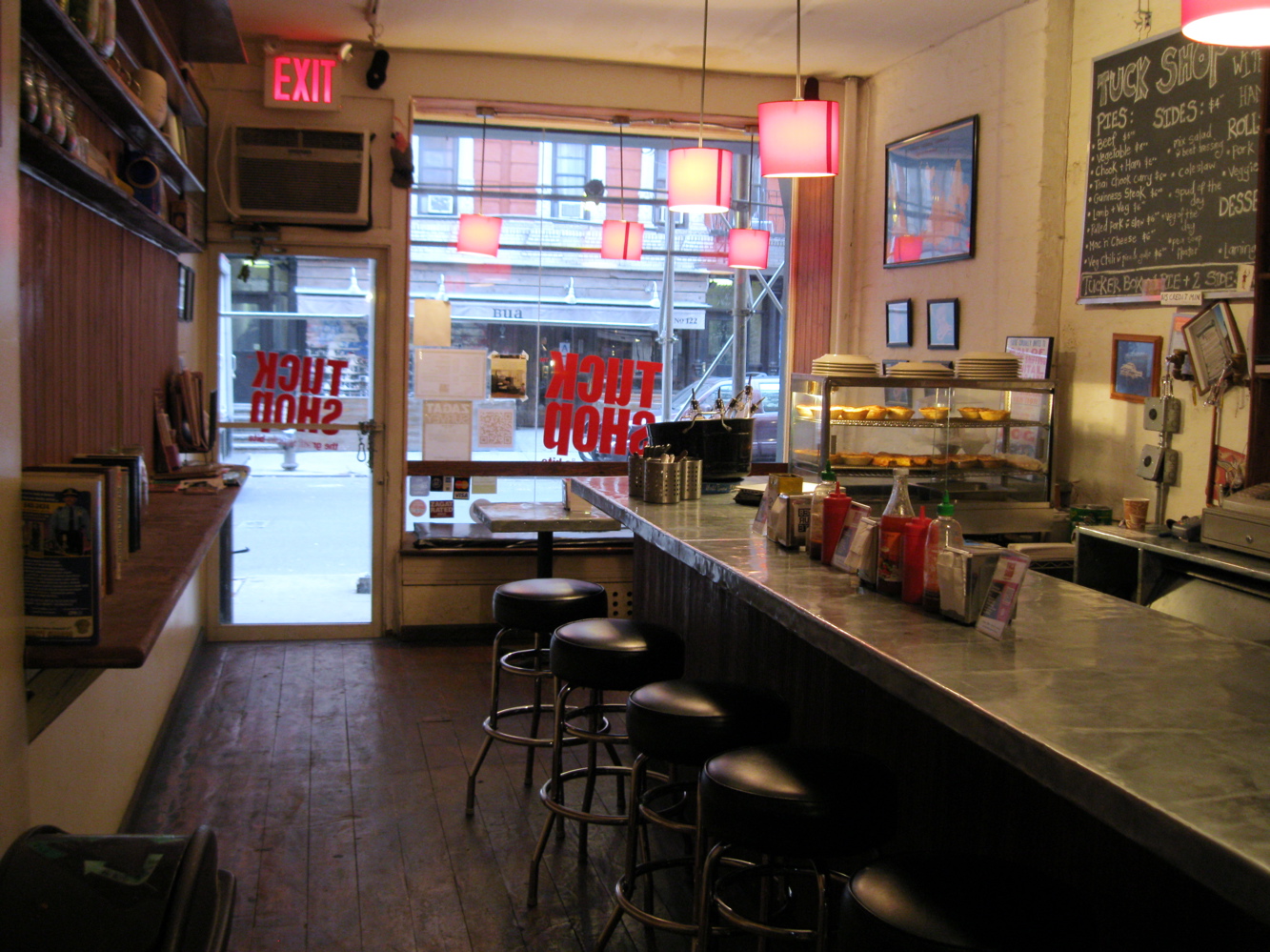
It’s a little shop with just a couple of tables and a counter with five stools, because most people follow Australian tradition and eat hand pies while on foot. Still, it’s cozy and festooned with the things you find in every Australian home, like a cricket bat, a boomerang, and a calendar showing all the pubs in Melbourne.

The hot pies are on view in a pie case and described in chalk on a blackboard. They were served on my visit by a genial Australian counter man named Isaac. I discussed my options with Isaac at length, learning in the process that chook means chicken, as in — per Isaac’s example — “Put the chook in the oven, love.”

Pull up a stool to dine in New York at Tuck Shop
St. Mark's Place.
Still, I declined the Thai Chook Curry pie, choosing instead the Traditional Beef pie and the Lamb and Veg pie, two of the most popular selections. They were both hot and piquant and satisfying enough to make a fine meal for $12. Isaac was impressed that I ate both.

Later I stopped at the First Street store, which is similar to the St. Mark’s store except that it has the table on which the pies are made and two inflatable kangaroos. It also had an Australian named Lincoln Davies, who owns the stores, even though he came to America to do the opposite of work.

“I came here with the idea of a two-week holiday,” he told me. But he couldn’t help noticing that America was dangerously short on meat pies. He made it his mission to help us out. A few years later he and his partner, Niall Grant, were running the first Tuck Shop, daringly free of auto parts.

Patrons enjoy no frills meat pies at Tuck Shop in New York City
East First Street.
Like all attempts to change eating habits, it has had challenges, Lincoln said: “ ‘Meat pie’ to an American conjures up nothing like this.” New Yorkers see ‘pie’ at a takeout and expect to have pizza pie. Anglophiles know English pies, which Lincoln refers to as “gelatinous.”

Australians, however, know their continent’s mass-produced gas-station pies, and so tend to regard the Tuck Shop offerings as gourmet fare. One such Australian was in the First Street store eyeing Lincoln and me as we talked. Lincoln was underselling his product, the man finally complained.

“In Australia, eating meat pies is something you do very casually,” said the Australian, Peter Freudenberger. “It’s not a fine dining thing. This place replicates the experience, but you get good food. In eighteen years in Australia I never saw a pie being made — just like you never see a hot dog being made here.”

Lincoln accepted the compliment. But the meat pie, he said, still battles — even after people have come in, tried it, and liked it. “Once they try them,” he said, “they get stuck on one, and we have to kind of wean them off it and get them to try another.”

Cooks in the back stretch dough for meat pies at Tuck Shop in New York City

Try another at Tuck Shop, at 68 East First Street, 115 St. Marks Place, and Chelsea Market Ninth Avenue, New York City.

Tuesday, September 20, 2011

The Old Season: The Beating Goes On — And On — At "Stomp"

Stomp Orpheum Theatre New York City Drummer
By Mitch Broder

I once took a cute little nephew to the East Village to see “Stomp.”

The cute little nephew has just been named a manager at Walgreens.

This is not to say that the show guides kids to positions with drugstore chains. It’s just to say that it has now been running long enough to have done it.

“Stomp” is the fifth-longest-running show in Off-Broadway history. It opened in February 1994. It’s not close to having as many performances as “The Fantasticks” — which ran for forty-two years and is running again — but it is close to having as many performances as Walgreens has drugstores.

This is commendable, when you consider that it has no plot, no dialogue, no music, and no lyrics, not to mention no flying, though it does have some pretty good dangling. It has stomping. It has banging. It’s ninety minutes of stomping and banging. If that gives you a headache, buy earplugs. There’s a Walgreens a block away.

Stomp Orpheum Theatre New York City Cast
The show photos are by one of the show's creators, Steve McNicholas.
 This is a previous cast. You can only bang for so long.
In honor of the job promotion, I revisited “Stomp.” The show’s from England, but after seventeen years it’s an indelible part of New York. It’s at the Orpheum, one of the theaters that once had shows performed in Yiddish. The show I wish I could see there now is the reaction of the Yiddish shows’ audiences to “Stomp.”

The theater is a dump. Intentionally. The whole space is done up like a junkyard, jammed with things to stomp and bang on. Surrounding you on the walls are beat-up pots, pans, grilles, grates, hubcaps, fan blades, street signs, sinks, tanks, springs, and at least one automobile bumper.

I was also surrounded by twenty-five kids from Venezuela. Groups like these tend to be the audience at shows that run for seventeen years. But I liked them. They got me in the mood for noise. And in a moment of uncharacteristic luck, the seat in front of me was claimed by a short one.

A tough-looking guy in dreadlocks walked onto the stage, sweeping. He glared at the kids from Venezuela, who responded appropriately by giggling. He was joined by six other men and one woman, and soon they were all doing synchronized sweeping. You want Rockettes, you go to Radio City. Down here you get street rats with push brooms.

The eight scrappy characters then proceeded with the performance of precision percussion played on scrap. They jiggled matchboxes. They crackled bags. They slammed metal folding chairs. They beat on sinks suspended from chains around their necks. They did a flame dance with Zippos. I inhaled the butane.

It all built like a fireworks show, until, by the end, everybody was everywhere banging on everything.

I still liked it all. But I liked the matchboxes better than the sinks. When you see a show once every decade, you can observe your aging process.

The place was nearly full on a Wednesday night, and the audience was very happy. It’s impossible, but the loudest thing I heard all night was the ovation. As he watched people rise, a Venezuelan boy near me gave the show the ultimate compliment. He leaned over to me and asked earnestly: “It’s over? Or is this the middle?”


Stomp Orpheum Theatre New York City Vintage Destination

Find your rhythm at “Stomp,” at the Orpheum Theatre, 126 Second Avenue, between Seventh Street and St. Mark’s Place, in Manhattan.