Showing posts with label St. Mark's Place. Show all posts

Friday, June 7, 2013

Old Yet New in New York: Papaya King Crowns the East Village

By Mitch Broder

They snap downtown just the way they snap uptown.

That’s all that matters. Papaya King East Village is a success.

Yes, the hot dogs that gave a second career to tropical fruit drinks have ventured from East 86th Street to St. Mark’s Place. Thus, Papaya King has a second location for the first time in decades. And the dogs traveled well. Here, too, they’re one of the best bites of New York.

The new store is three times as big as the old, and it has a concrete porch. It takes some time to acclimate to all that luxury.  But the hot dogs are the same, which is to say perfectly tasty and snappy, as are the buns, which is to say perfectly fluffy and crunchy.

As is the papaya drink, which is to say perfectly creamy and frothy. It’s unlike any other fruit drink you know. It’s mysterious. And best left that way.

Papaya King, born on that uptown corner in 1932, has had other branches, but they disappeared despite the perfection. The original location was bought by a group of investors three years ago. The new store is their first attempt to build on history.

“It’s a good match for the brand,” says Blake Gower, the group’s head of development. “It’s a quintessential New York experience on a quintessential New York street.” He’s especially proud of the porch: “It’s one of the key design elements. It kind of makes this place feel like it’s always been here.”


Blake wanted to have a place that looked new to people who like new things and old to people who like old things, and he got as close as you could expect. The classic neon sign, for instance, is new and yet manages to say Old New York in the middle of the city’s body-piercing corridor.

Inside, the walls preserve a Papaya King tradition: little signs designed to enlighten you about frankfurters and fruit. But here they’re tailored to the neighborhood, as in: “Right across the street from where you’re standing was the legendary Five Spot Jazz Club. All the greats played there. Bet they wished for franks after shows.”

Blake dug even further back to come up with the bamboo counter and the thatched grill awning laden with artificial fruit. They recall Papaya King’s origin as a stand called Hawaiian Tropical Drinks, where just fruit juice was sold, sometimes by a man crowned by a pith helmet.

The porch has wooden chairs that make you feel like you’re at the old homestead, until you notice the view of the St. Mark’s Hotel, the St. Marks Ale House, and Karaoke St. Marks (and you get a snootful of smoldering sandalwood from the nearby incense stand).


It’s a unique blend. But it could be what the neighborhood needs, since Papaya King could be what every neighborhood needs. Among nearby competitors is Japadog. But Japadog has hot dogs with bonito flakes. Papaya King has two hot dogs and a fruit drink for five bucks.

It has toppings, too, though not bonito flakes. But try a couple of these dogs straight.

As the longtime slogan promises: “Our Franks are Tastier than Filet Mignon.”


Eat royally at Papaya King, at 3 St. Mark’s Place, between Cooper Square and Astor Place, in New York City.


READ THE WHOLE STORY OF THE ORIGINAL PAPAYA KING — AND OF DOZENS OF OTHER CLASSIC CITY SPOTS — IN “DISCOVERING VINTAGE NEW YORK,” COMING ON JUNE 18 AND ON SALE NOW!


Tuesday, January 10, 2012

Strangely New York: Japadog Brings a Taste of Japan From Canada

The grand opening of the new in New York Japadog restraurant
By Mitch Broder

Mr. Mustard and Miss Ketchup stood before the golden fringe, confirming the event’s significance in New York restaurant history.

Then the man in the giant red bow tie spoke and I wrote down what he said, confirming my significance in New York journalism history.

Noriki Tamura a respresentative of Japadog New York City makes an announcement
“Hello, everybody,” I wrote. “I, Noriki Tamura, represent Japadog. And … today is one of the greatest moments in the history of Japadog. We finally open our new location in New York, which is, of course, the greatest city of the world.”

He got that right, but only because of the opening. Before that, New York had an indefensible culinary gap. We may have had our hot dog restaurants, and we may have had our Japanese restaurants, but only now do we have our first Japanese hot-dog restaurant.

Only now do we have the Terimayo, the hot dog with teriyaki sauce, Japanese mayonnaise, and seaweed. Only now do we have the Kobe, the hot dog with miso sauce, wasabi mayonnaise, and caviar. Only now do we have the Okonomi, the pork sausage with bonito flakes and fried cabbage. And only now can we have those hot dogs with French fries and a Coke.

A delicious hot dog from the kitchen of the new in New York Japadog
That's my dog.
You can see why I made it my business to attend the grand opening of Japadog: I had to have that dog with the teriyaki sauce. I knew that it would be there. What I didn’t know was that hot dogs would be free to the first fifty customers, and I would be number thirty-eight.

Actually I was number one, because I arrived ahead of the opening to speak to the man in the giant red bow tie, who had made the opening possible. Noriki represented Japadog because he invented Japadog. I took him seriously, even though he also wore a sash that said “BOSS.”

He started Japadog in 2005 as a hot-dog stand in Vancouver, shrewdly pouncing on Canada’s own failure to sell German sausage with Japanese toppings. By last year, he was running four stands and his first Japadog store. With a record like that, there was no question that he could start here at the top.

A line forms to order at the new in New York Japadog
That's Joey.
“We have a style that’s totally different,” he said if I can trust Tatsuki Kida, who translated. “It’s one-of-a-kind. It beats all the street vendors.” I asked if he had plans for more stores. “If we succeed in this,” he said, “we’ll be all over New York — and the world. We want to make everyone happy eating hot dogs.”

A few minutes later he was standing on a chair on the sidewalk, repeating that goal. I couldn’t very well disappoint him, so I got in line. I ordered the Terimayo, and while waiting for it I spoke to Joey Heimgartner, who was not only a woman but also the first customer at America’s first Japadog.

“I’ve been walking by, waiting for this place to open for weeks,” she said. “Now it’s finally open, and it’s very exciting.” She needed a change from the Basil Popcorn Chicken she’d been getting at TKettle nearby. She got it in Japadog’s arabiki pork sausage with cheese, which is known as the Love Meat.

I stuck with my Terimayo, with butter-and-soy-sauce fries and a Coke. It was delicious, and not just because the meal would have cost me eight bucks. The bun was large, soft, and warm. The dog was large, tender, and juicy. The seaweed inexplicably worked. And you can’t go wrong with teriyaki and mayo.

I felt happy for Noriki. He worked hard to get here. I knew that some hot-dog chains have failed, but probably none of them had bonito flakes.

On my way out, I thanked Noriki and wished him and Japadog well.

I never did squeeze Miss Ketchup, but don’t think that I didn’t consider it.

New York City diners enjoy a dog at Japadog
Squeeze into Japadog, at 30 St. Mark’s Place, between Second and Third avenues, in Manhattan.

Wednesday, January 4, 2012

Strangely New York: The Pies are Still Hot at Tuck Shop

Near perfect pies adorn the racks at Tuck Shop
By Mitch Broder

At Tuck Shop they sell meat pies without windshield wiper fluid, which may seem inconvenient to New Yorkers but proves liberating to Australians.

The Tuck Shop sign reads The Best Winter PiesMeat pies in Australia are like hot dogs in America; they’re displayed at gas stations and convenience stores, where, in a weak moment, you might buy one. Tuck Shop sells Australian meat pies at meat-pie shops, which means an extra stop for wiper fluid but less chance of thinking it’s your beverage.

So far it’s worked, since the Tuck Shop on First Street is in its seventh year, and has been joined by a shop on St. Mark’s Place and another at Chelsea Market. In Australia it’s always meat-pie season, but in New York we’re in the heart of it, so I stopped in at the St. Mark’s shop, secure that in winter a pie lunch is healthy.

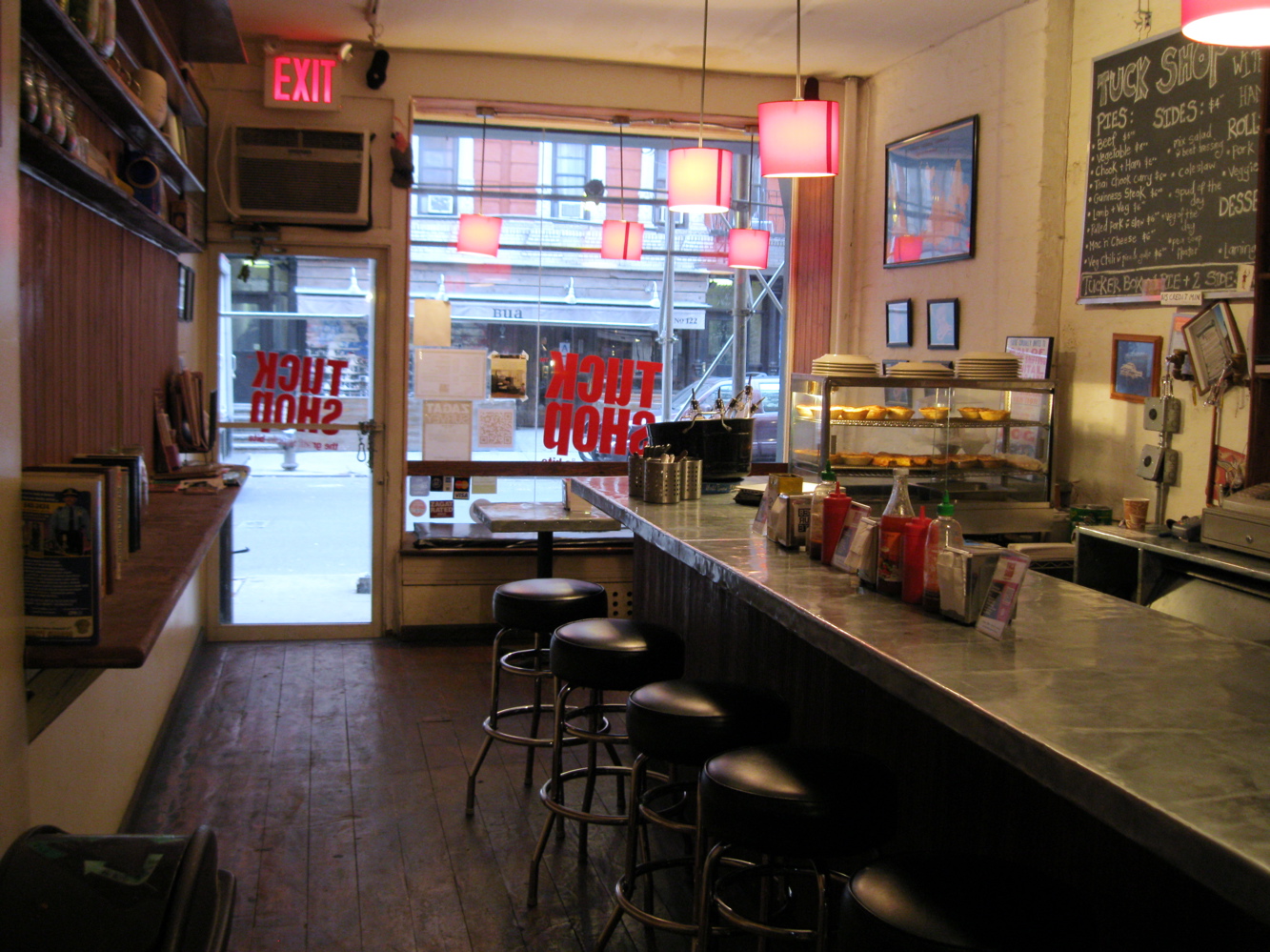
It’s a little shop with just a couple of tables and a counter with five stools, because most people follow Australian tradition and eat hand pies while on foot. Still, it’s cozy and festooned with the things you find in every Australian home, like a cricket bat, a boomerang, and a calendar showing all the pubs in Melbourne.

The hot pies are on view in a pie case and described in chalk on a blackboard. They were served on my visit by a genial Australian counter man named Isaac. I discussed my options with Isaac at length, learning in the process that chook means chicken, as in — per Isaac’s example — “Put the chook in the oven, love.”

Pull up a stool to dine in New York at Tuck Shop
St. Mark's Place.
Still, I declined the Thai Chook Curry pie, choosing instead the Traditional Beef pie and the Lamb and Veg pie, two of the most popular selections. They were both hot and piquant and satisfying enough to make a fine meal for $12. Isaac was impressed that I ate both.

Later I stopped at the First Street store, which is similar to the St. Mark’s store except that it has the table on which the pies are made and two inflatable kangaroos. It also had an Australian named Lincoln Davies, who owns the stores, even though he came to America to do the opposite of work.

“I came here with the idea of a two-week holiday,” he told me. But he couldn’t help noticing that America was dangerously short on meat pies. He made it his mission to help us out. A few years later he and his partner, Niall Grant, were running the first Tuck Shop, daringly free of auto parts.

Patrons enjoy no frills meat pies at Tuck Shop in New York City
East First Street.
Like all attempts to change eating habits, it has had challenges, Lincoln said: “ ‘Meat pie’ to an American conjures up nothing like this.” New Yorkers see ‘pie’ at a takeout and expect to have pizza pie. Anglophiles know English pies, which Lincoln refers to as “gelatinous.”

Australians, however, know their continent’s mass-produced gas-station pies, and so tend to regard the Tuck Shop offerings as gourmet fare. One such Australian was in the First Street store eyeing Lincoln and me as we talked. Lincoln was underselling his product, the man finally complained.

“In Australia, eating meat pies is something you do very casually,” said the Australian, Peter Freudenberger. “It’s not a fine dining thing. This place replicates the experience, but you get good food. In eighteen years in Australia I never saw a pie being made — just like you never see a hot dog being made here.”

Lincoln accepted the compliment. But the meat pie, he said, still battles — even after people have come in, tried it, and liked it. “Once they try them,” he said, “they get stuck on one, and we have to kind of wean them off it and get them to try another.”

Cooks in the back stretch dough for meat pies at Tuck Shop in New York City

Try another at Tuck Shop, at 68 East First Street, 115 St. Marks Place, and Chelsea Market Ninth Avenue, New York City.

Sunday, September 4, 2011

Holiday Cocktail Lounge: It's Everything It Ever Was

Holiday Cocktail Lounge New York City Bar
By Mitch Broder

When you see a place with an awning that says “Holiday Cocktail Lounge,” it’s wise to assume that the place won’t live up to the awning.

They just don’t make Holiday Cocktail Lounges the way they used to.

Except that this Holiday Cocktail Lounge was made when they made them the way they used to.

Holiday Cocktail Lounge New York City Bar Interior Banquette
It’s a shadowy hideaway of tufted banquettes and wood-grain Formica tables, beyond a convivial circular bar ringed by tubular chrome-backed stools. The paneled walls sport glowing sconces that can transport you to decades past. The floors sport festive tiles that can transport you to a booth in the back.

The reason the lounge is so well-preserved is because its original owner preserved it for as long as he owned it, which was over forty years — and also because the new owner is his son, who has seen no more reason to wreck a perfectly good place than he did.

“We’re the keepers of the flame,” says the lounge manager, Jeff Tendler. “People love this place. Like they say, if it ain’t broke, don’t fix it. We have fun. We mix it up. We don’t make a fortune here. We’d rather our customers have a good time.”

The original owner was Stefan Lutak, who was born in Ukraine, where he reportedly played professional soccer and later deserted the Russian army. He and his wife, Jeri, came here in 1949, and Jeri bought the bar in 1965. Stefan’s memories of the lounge are posted near the entrance.

He says that the onetime beauty parlor became a bar in 1936. “It was an all Italian place when we took over,” he writes. “The customers played cards, pool and bet on the horses.” Jeff says that it was a restaurant named Casablanca’s, which had in residence a bookie who was called Jingles because his office was the phone booth.

Holiday Cocktail Lounge New York City Bar Interior Memoir
Stefan continues: “We mostly served tough working men like Italians and Ukrainians. Over the years we have become close to the regulars and losing one is like losing an old friend.” He also served local notables like the poet W.H. Auden, along with visiting notables like the actress Shelley Winters.

He dealt with the punk era by graciously serving the punks, while simultaneously insisting upon keeping them in line. He writes that he kicked one kid out because he “came in with terrible clothes on. His face was red with anger. He left. But you know what, he came back and his clothes were better.”

Stefan died at 89 in February 2009. Jeff says that he was still lugging beer cases around late into 2008. Jeff, with Stefan’s son Roman, reopened the bar soon after. Patrons were afraid of what they’d do to the place, then relieved when they did nothing.

It’s now an official dive bar, with the attendant attractions of charm and cheap beer, along with the mandatory year-round multicolored Christmas lights. The prices, Jeff says, are a bonus, but it’s the charm that’s the draw. If patrons stray to trendy bars, he says, they usually return to his leatherette seats.

“The one constant about New York City is its changeability,” Jeff says. “People like to explore new places. But they like to come back to where they’re comfortable. Coming here is like slipping on an old pair of jeans. People don’t come in here for drinks with fruit purées.”

Holiday Cocktail Lounge New York City Vintage Destination